Systemic LLM Agent Degradation Signals That Emerge Only Across Run Populations Not Individual Traces
Agent decay shows up only across many runs, not in any one trace.

To group recurring AI agent failure patterns automatically, teams need to compare runs by failure category, step count, session depth, and output diversity. Step-count collapse, entropy accumulation, and coordinated drift are visible in those distributions. To catch them early, teams need population-level measurement linked to issue routing and regression evaluations.
Why agent degradation often goes unnoticed until users complain
Liu et al. 2026 document a production system spanning over 100,000 agent interactions in which agents appeared to complete tasks while silently passing degraded output downstream. There was no error message, timeout, or alert. The agent returned a result, the pipeline continued, and standard monitoring reported green. A system could remain available while the quality of its decisions deteriorated.
This gap makes silent degradation difficult to diagnose. An individual result may look plausible enough to pass downstream, while repeated results reveal a systematic loss of consistency or task accuracy. Monitoring that checks whether a call completed cannot establish whether the agent population is becoming less reliable. By the time users report poor results, the relevant evidence may already be spread across many otherwise unremarkable runs.
What step-count collapse and entropy accumulation actually look like as signals
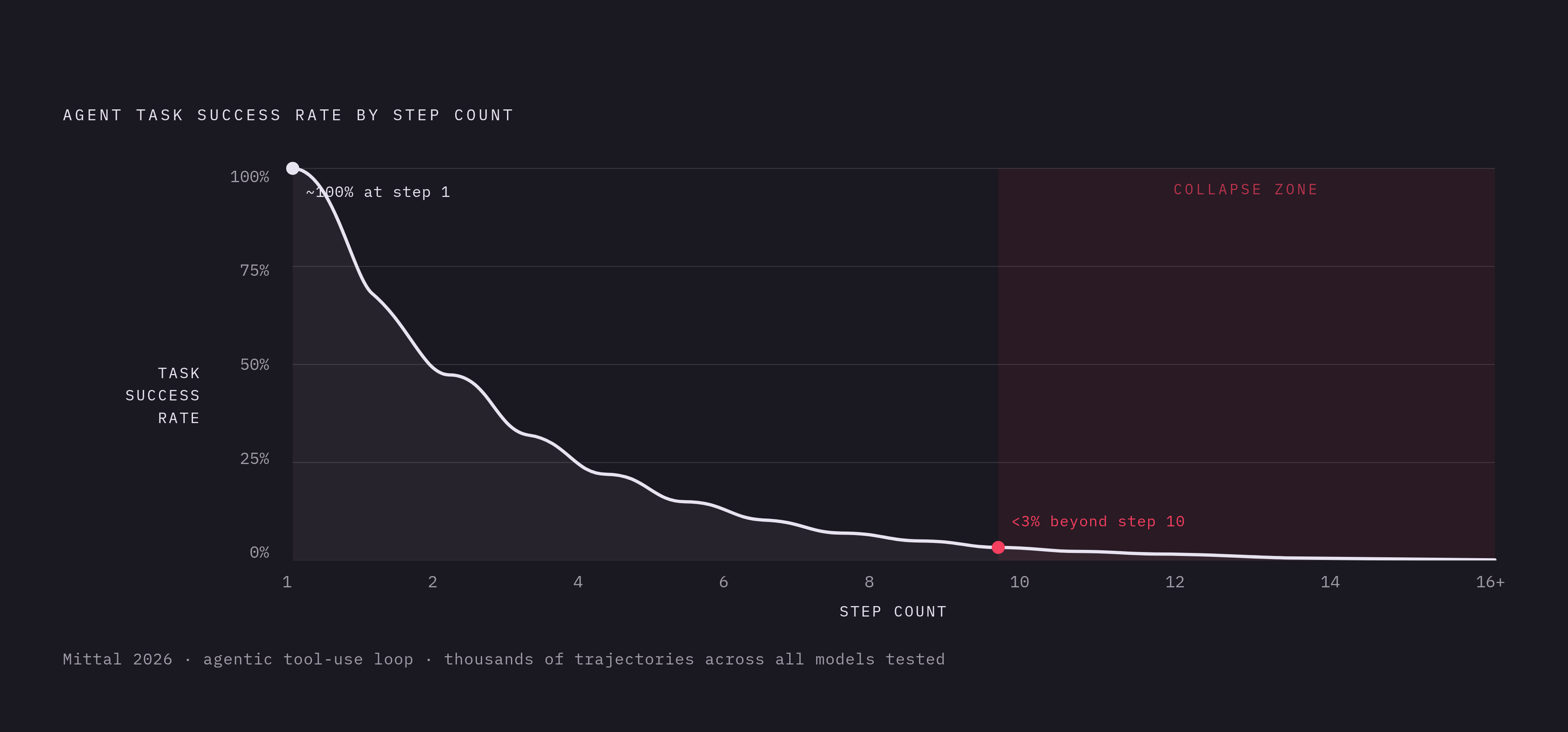
Mittal 2026 describes task success as following a geometric law governed by a single per-step reliability parameter. Across thousands of trajectories that were analyzed, every model tested in the agentic tool-use loop fell from near-perfect success to near-zero within sixteen steps. The geometric fit was not universal across model-task combinations, but the observed collapse gives the signal a clear shape.
Mittal found that bounding the context window steepened the decay, contradicting the assumption that compressing history necessarily makes a long-running agent more dependable. This is a horizon-dependent signal, meaning that its defining relationship is between task success and the number of steps. A failure at a particular step is only one observation. To see the degradation curve, teams need runs with different trajectory lengths.
Liu et al. formalize a second pattern as the Entropy Principle, expressed as S(t) = S₀ · e^(αt). Here, system entropy means measurable loss of output consistency, task accuracy, and cross-session coherence, with α measured empirically across multiple architectures and tens of thousands of controlled trials. Under the conditions the study describes, entropy increases monotonically with interaction rounds. A new session does not automatically erase it.
“Your Agents Are Aging Too” identifies four mechanisms, namely compression aging, interference aging, revision aging, and maintenance aging. Each leaves a different population signature. That distinction prevents “aging” from becoming a catch-all explanation for any worsening result. Both the shape of the decline and the interaction history help distinguish which mechanism may be operating.
Why these signals cannot appear in a single trace no matter how carefully you read it
A trace records one trajectory through state space. It can expose an incorrect decision, repeated tool call, or premature stop, but it cannot establish how often those events occur elsewhere. In particular, it cannot show that short trajectories succeed while long trajectories fail without comparable runs at other lengths. The curve is a property of their distribution. More detailed inspection of one trace does not supply the missing observations.
Entropy accumulation has the same structural constraint across time. A run can show its current output, but it cannot establish whether outputs across sessions have become less varied or less coherent. Liu et al. describe a case where accuracy remained flat while output diversity collapsed. An accuracy-only monitor would report stability even as the population lost diversity, because correctness and variation measure different properties.
Research on seven production failure modes found that no standard metric detected more than two. The modes included cascading decision errors, distribution collapse, and proxy goal convergence, illustrating how a logged outcome can leave the broader causal pattern unresolved. Trace access is also uneven in practice. The 2026 LangChain State of AI Agents survey found that a substantial share of organizations had observability but could not inspect what their agents did at each step. Population analysis therefore complements trace visibility.
Liu et al. note that silent failures are “routinely misattributed to bugs or configuration errors.” Local coherence helps explain that mistake. When the actions in a trace look plausible, investigators may look for a bug in that run and overlook a change in the run distribution. A trace remains useful evidence about an instance, but it cannot by itself establish the prevalence or trajectory of the failure class.
How multi-agent topology amplifies population-level pathologies
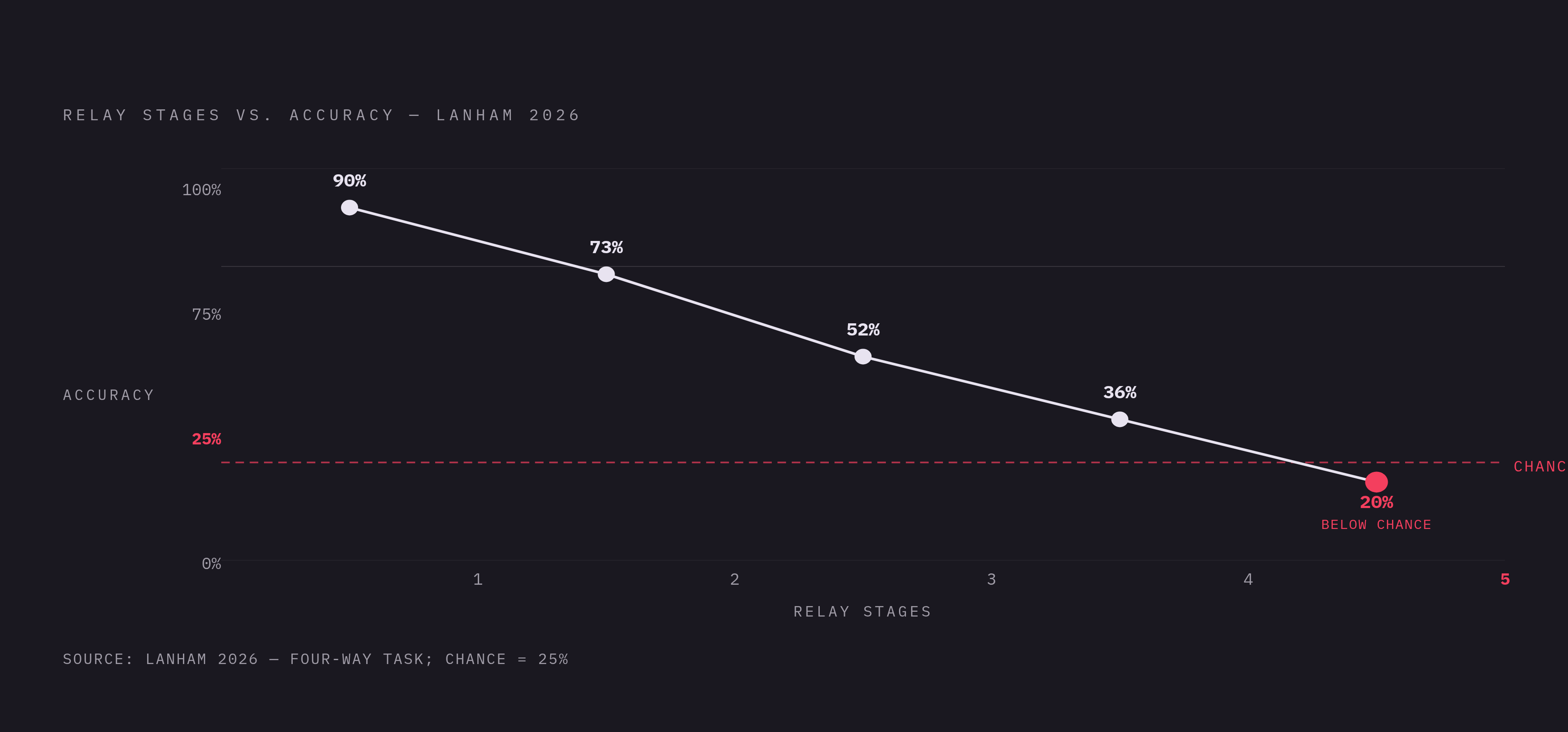
Multi-agent systems have two sources of risk across the population. One is degradation caused by the architecture through which information passes. Lanham 2026 found that adding relay stages without new signals on a controlled four-way task reduced accuracy from roughly nine in ten at one stage to roughly two in ten at five stages, below the chance baseline. The pipeline topology changed the outcome distribution. This was not evidence that a particular call was defective.
A Google scaling study found a related dependence on task structure across five canonical architectures. Centralized coordination helped on parallelizable work, while every multi-agent variant substantially degraded performance on sequential planning tasks. These findings concern how architecture’s interaction with the work determines the benefits of adding agents.
De Wynter 2026 found that second mechanism in three multi-agent social systems. Collective behavior was statistically distinct from the sum of individual outputs, and population-level pathologies occurred even in safety-tuned and monitored systems. Coordinated activity by a subset drove those pathologies. A majority did not need to behave abnormally for the collective system to develop an abnormal pattern.
De Wynter’s framework measures Shannon entropy of interaction structure to track how agents organize their interactions without judging each agent’s language. Open-ended systems showed sharp, phase-transition-like changes, while coordinated drift could unfold at a pace that per-agent alerts miss. Individual monitoring remains necessary, but the interaction graph supplies evidence at a different level.
The postmark-mcp supply-chain attack in 2025 illustrates a separate shared exposure. A malicious MCP server silently sent a copy of every outgoing email to an attacker-controlled address because there was no tool-call authorization layer. The agent trusted any installed MCP server. This shows why understanding a population-wide failure requires examining the shared exposure across email-send incidents.
What the MAST failure taxonomy and framework-level divergences reveal about where population signals originate
The MAST benchmark sorts failures that keep happening into specific categories. Task-verification failures, including incorrect verification, incomplete verification, and premature termination, account for roughly a quarter of observed failures. Step repetition accounts for roughly a sixth, while unawareness of termination conditions accounts for roughly an eighth. These ratios describe a population. Their value is to identify which recurring behaviors deserve distinct measurements.
Loop repetition provides a direct connection between a category and trace attributes. In OTLP traces, it manifests as a rising callCount on spans sharing the same gen_ai.agent.name. A healthy ReAct agent loops 2–4 times, while counts above six without a termination condition provide an anomaly to detect through aggregation across runs. The repeated span is the local observation. Its frequency and distribution reveal whether loop accumulation is becoming a systemic problem.
Framework behavior changes how these observations should be interpreted. A step-limit signal in Mastra is structurally different from one in LangGraph, so a common label does not establish equivalent behavior. Population variance may originate in the framework. Comparing counts without accounting for reporting behavior can therefore obscure the source of a change. The relevant measurement is not a generic error rate, but a framework-aware distribution tied to a named failure category.
How to instrument for population-level signals in practice
For engineering teams, the practical shift is to aggregate span attributes across comparable run cohorts. Step count, session depth, loop counts, output diversity, and task success need to be available together. Each answers a different diagnostic question. Automatic grouping of recurring AI agent failure patterns then means assigning repeated observations to categories such as verification failure or loop non-termination, rather than producing another queue of individual trace IDs.
Step-count distributions should be separated by task type, with runs bucketed by horizon length and success rate plotted against step count. That comparison exposes the geometric decay curve. Session-depth tracking requires an interaction-round counter attached to each trace so that accumulation across rounds can be reconstructed. Without that counter, a time series lacks the session history needed to interpret it.
Loop monitoring should add up callCount for spans from the same agent and flag runs that go past the chosen repetition threshold. Output diversity needs a separate measurement. Token entropy or semantic similarity distributions across a cohort can expose narrowing outputs even when accuracy remains stable. For multi-agent systems, Shannon entropy of interaction structure shows how coordination changes in a model-agnostic way, without the monitor having to read agent outputs.
The trace structure determines which comparisons are possible. A flat list of LLM calls does not preserve the parent-child relationships that population analysis needs, while a span tree does. Scores attached to spans link evaluation results to the parts of the execution they score. Replay capability and a CI gate extend that record into a debugger, allowing a discovered failure to become a testable case.
“Who Drifted: the System or the Judge?” and the ICML 2026 paper “GAUGE” identify judge drift as a confound in agent evaluation. A judge that changes can hide real degradation or make it look as though results have grown worse. The recommended safeguard is to use a scorer from a different model family than the agent being evaluated.
With LLM-as-judge agreeableness bias, the judge has a high True Positive Rate and a low True Negative Rate. The judge recognizes correct outputs well but misses incorrect ones, allowing false negatives to accumulate into missed population degradation. A practitioner pattern for reducing false-positive alerts is to sample a small fraction of production traces continuously and alert on three consecutive failures in the same category. When new production failure modes are found, they should then automatically become new evaluations.
Shifting from reactive detection to a continuous feedback loop
Population signals become operationally useful when they reach the people and systems that can fix the underlying failure. A grouped issue should describe a recurring category, such as verification failure, loop non-termination, or entropy-driven drift. The trace remains supporting evidence. If the team fixes one instance without saving the pattern in its tests, those tests will leave later instances uncovered.
The supported workflow routes those grouped issues to Slack, Linear, or a coding agent via MCP without requiring manual trace archaeology. Once a fix is confirmed, it becomes an online evaluation that runs against new production traces. CI regression coverage then tests the known failure mode before the next deployment. The loop has a persistent memory of failure. It no longer depends on an engineer remembering which earlier incident a new trace resembles.
The 2026 evaluation landscape supports continuous coverage through cheap distilled evaluators, with agent-as-judge used selectively for deeper verification. Multi-dimensional metrics replace single-number accuracy, while evaluations embedded in the agent runtime serve as guardrails.
For the silent downstream degradation Liu et al. describe, success-by-step and diversity-by-session measurements would provide evidence beyond green execution monitoring and establish what the detection system must observe to recognize a developing pattern before user complaints become the first useful signal. Earlier detection depends on routing that evidence into a fix and a durable evaluation.