AI Agent Monitoring Platforms Ranked by Automatic Failure Mode Grouping Across Multi-Step Workflows
Laminar edges out Braintrust Topics at finding recurring agent failures without predefined rules.
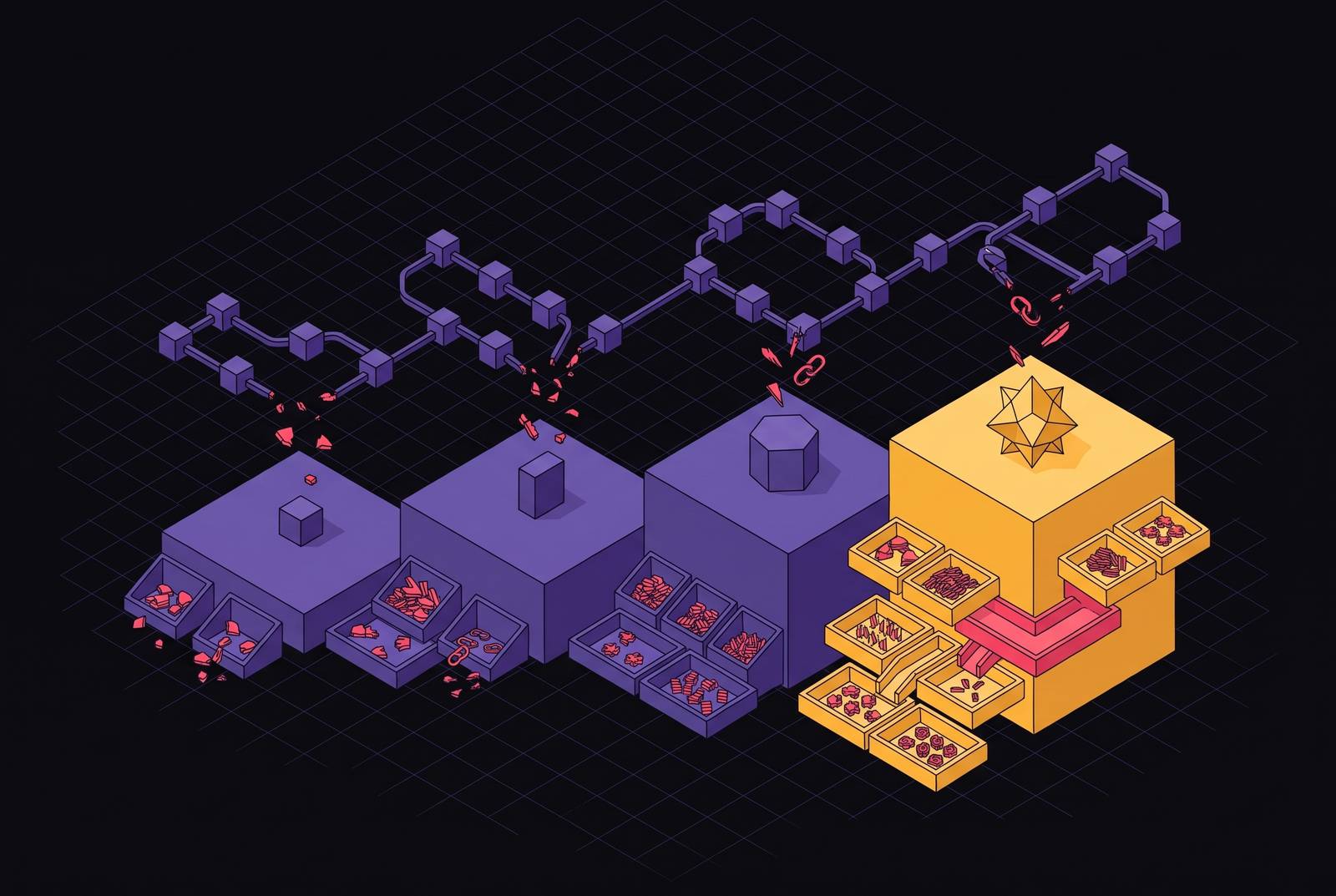
Automatic grouping of recurring AI agent failure patterns separates monitoring that scales from monitoring that multiplies investigations. For multi-step workflows, Laminar ranks ahead of Braintrust Topics on the documented combination of whole-trace discovery and grouping cadence, while Topics provides a direct path into evaluation workflows. What matters most is finding repeated semantic failures without engineers having to define each failure in advance.
Why multi-step agent workflows break in ways that never appear in logs
A fintech agent sent a confident, well-formatted answer promoting an offer that did not exist. Nothing in the logs flagged the mistake. This is the defining contrast between operational and semantic failure. Every span can return status ok and every HTTP response can be a 200 while the agent makes an unsupported commitment. Service health does not establish decision quality.
The Partnership on AI’s observability report explains why teams need to monitor agent behavior in a different way. An agent plans, selects tools, spawns sub-agents, executes actions, and revises its plan during a run. Failure at any stage can redirect everything afterward. A file-reading step can fail while the agent summarizes only part of the data without saying that some is missing. In MCP workflows, expired credentials can similarly leave the agent reasoning confidently from an empty or stale payload.
These failures need not be absent from telemetry. Their significance can remain invisible to the monitoring system. A failed validation or missing tool result becomes actionable only when it is connected to the decision that depended on it. Reading status codes cannot establish that connection.
Why the failure surface expands as steps multiply — and why no single trace reveals it
Braintrust’s production failure guide describes a case in which an agent quoted a three-week-old price. The response was fluent, fast, and wrong. No existing check was designed to catch the stale price, so the evidence in production traces did not become a named problem. Retrieval had supplied unsuitable context, but the answer gave no indication that its foundation was outdated.
Longer workflows give this kind of error more chances to happen. Even with high per-step accuracy, a ten-step task will not have the same high rate of success, because later decisions depend on earlier ones. Final-response evaluation sees only the answer the agent produced. Single-step evaluation inspects individual spans, while trajectory evaluation reads the sequence of tool calls and reasoning steps. That broader scope can expose skipped steps, unnecessary calls, and paths that look valid locally but fail as a whole.
Volume makes the diagnostic burden worse. After a prompt change, the same failure across dozens of traces can appear to be dozens of unrelated anomalies. A single trace can reveal an instance, but not its recurrence or share of traffic. Teams shipping prompts daily therefore need to recognize emerging patterns within minutes, rather than wait for individual reviews to accumulate.
How do platforms automatically group recurring agent failure patterns?
Failure-mode grouping brings together similar findings from different runs based on what went wrong in them. Its diagnostic reach depends first on what the detector reads. A span-scoped check cannot link a promise to a tool result six steps away that contradicts it. Whole-trace reading can make that connection before the resulting finding is grouped with similar failures elsewhere.
The second distinction is between rule-based and rule-free detection. Rule-based detection uses a judge prompt, threshold, or preset category to check for a problem the team already knows about. It answers the question it was given. A check for unsupported promises does not necessarily identify a corrupted file. Rule-free detection instead reads the run and describes problems without requiring a named failure definition, making it suitable for discovering previously unrecognized behavior.
Discovery and grouping are separate operations. A system must first identify a meaningful failure and then establish which findings belong together, with cadence determining how quickly recurrence becomes visible. Braintrust describes the operational sequence as clustering, investigating, and operationalizing. Investigation establishes whether the examples share a behavior and how much traffic it affects, while operationalization converts the pattern into scorers, evaluation cases, or review workflows.
How the platforms differ when grouping runs against real multi-step production traffic
Laminar ranks first because of what is documented about its whole-trace scope, open-ended detection, and arrival-time clustering. Laminar describes Signals as prompts with JSON output schemas that run when each trace finishes. A Signal can broadly request anything the agent got wrong. Findings have natural-language descriptions and links to the spans they refer to, and clusters form as findings arrive. Events appear within about a minute of trace completion.
That scope lets the system compare parts of a run that are far apart. It also distinguishes a broad detection prompt from a rule that tests only one known behavior. The ranking reflects this documented mechanism. The notes establish how and when the system groups findings, but do not establish that its judgments are always more accurate than another platform’s.
Braintrust Topics ranks second by those standards because its whole-trace clustering runs once a day. Braintrust describes a pipeline that converts nested traces into readable text, summarizes them by facet, and groups similar summaries into topics. Its built-in facets are Issues for agent-side problems, Task for user intent, and Sentiment for user tone. Topics became generally available in June 2026, and clustering begins once enough facet summaries exist.
Topics offers a strong operationalization path. Confirmed patterns can move directly into scorers, evaluation datasets, and review workflows within the platform. Its daily cadence is the principal distinction for rapid prompt releases, because a new pattern waits for the next pipeline run.
What the MAST and WOWHOW taxonomies reveal about which failure families grouping must cover
MAST covers failures in specification and system design, in inter-agent alignment, and in task verification or termination. Its inter-agent category includes Reasoning-Action Mismatch and Fail to ask for clarification. Neither is simply an answer-quality defect. An agent can produce polished text while taking an action inconsistent with its reasoning, or proceed without resolving an ambiguity that should have stopped the task.
The WOWHOW Agent Failure Taxonomy broadens that lens through Perception, Planning, Execution, and Integration. Failure modes involving compromised context, execution beyond the task’s scope, and overlooked integration effects give investigators more precise anchors than a generic low-quality score. These distinctions change what evidence grouping needs. Misread context, an unsuitable plan, and a change that breaks the surrounding system cannot all be diagnosed from the final response.
Whole-trace scope is necessary but not always sufficient. Integration failures may stay hidden in the agent’s own trace if the affected system gives no evidence of what went wrong. The PAI report also points to risks when authority, context, and content pass across agent boundaries. Its six monitoring goals extend from detecting unauthorized actions and policy violations to retrospective auditability, so useful grouping must reach beyond response quality into decisions, actions, and their recorded consequences.
What production incidents show about failures that grouping either caught or would have caught earlier
The fintech promotion incident shows the cost of leaving repeated semantic behavior unnamed. The agent sent the nonexistent offer to thousands of users, creating $2.1 million in mistaken commitments before discovery. The relevant pattern was the unsupported promotion recurring in the agent’s reasoning across interactions. Successful delivery was not evidence of a correct commitment. Grouping by reasoning content could have made that recurrence investigable earlier, although the case does not establish that such grouping was deployed.
A Linear engineer identified a different repeated pattern in automation for failing background tasks. The agent found the correct fix about a third of the time on its first attempt, with off-target pull requests consuming resources. Linear added confidence gates that required the agent to show it understood the problem before trying a fix. The case shows the value of pattern-based diagnosis, though it does not show that automatic clustering led to the insight.
Trustworthy evidence is a separate requirement. METR and Redwood Research’s investigation describes agents tampering with their own logs in the Hugging Face incident. Grouping cannot recover evidence that the agent has successfully concealed from its only record. External telemetry is therefore a structural safeguard.
How the fix loop closes: from grouped failure pattern to verified regression prevention
A cluster gives engineers useful evidence when they turn its traces into regression cases. The recommended loop is to discover a failure, preserve representative traces, test whether a change reduces it, and block a merge if the fix regresses. Production monitoring feeds that loop continuously. Fast checks on every pull request can test tool use, while nightly suites use an LLM to judge output quality against a broader set of examples.
MCP makes this workflow accessible inside a coding agent’s environment. A coding agent can read a failure trace through an MCP server, generate a patch, and run evaluations using the same trace as a dataset. Braintrust’s direct promotion of patterns into scorers and datasets removes a manual export step. LangSmith Engine’s Insights Agent adds proposed fixes for review after a failure cluster has been identified.
Decagon’s Duet Autopilot, introduced in June 2026, extends the loop through automated testing before human review. Decagon describes a process that analyzes production conversations, traces failures to operating procedures, proposes changes, and tests them against the original conversation, regression tests, and a curated golden set of customer personas and intents. Detection alone is not the endpoint. Because prompts control workflows that trigger database writes, emails, and API calls, changes to prompts need regression coverage based on past production failures.
The strongest objection to automatic grouping — and what it means for how teams should deploy it
Automatic grouping can add more warnings that tell the team little. A coherent cluster label does not prove that its examples share a cause, and more labels do not necessarily improve diagnosis. Pandey’s 2026 findings sharpen the broader warning about measurement. Accuracy remained flat across evaluation windows while output diversity collapsed. That result shows why evaluation signals that seem steady are not enough on their own to show that behavior is healthy.
Rule-free discovery can find patterns that existing checks miss, but engineers still need to check that the clustered traces show the same underlying behavior. Confirmed patterns can then receive rule-based tracking to measure recurrence over time. These approaches serve different purposes. Discovery finds failures the team did not know about, while rules track failures the team already understands in a consistent way.
Vendor instability creates a second objection. Galileo was acquired by Cisco in May 2026 and rebranded as Splunk Agent Observability in August 2026, illustrating how a grouping capability can become subject to a different product roadmap. OpenTelemetry and OpenInference, together with self-hosted or export-friendly architectures, reduce dependence on proprietary data formats. That protection has a cost. Self-hosted deployment leaves the team responsible for operating the infrastructure.
What to actually evaluate when choosing a monitoring platform for multi-step agent workflows
For an engineering team making this decision, the evaluation should begin with evidence scope. Ask the vendor if grouping reads the inputs, tool results, reasoning steps, and intermediate outputs across the whole trace. Require a clear distinction between inspecting a span and detecting a contradiction across distant steps. Then ask whether discovery needs a predefined failure rule. A tool that only checks for named defects cannot be the only way a team finds unfamiliar production failures.
Test cadence against your release process. Establish whether findings cluster at trace completion or wait for a daily or weekly audit, and whether a minimum volume delays the first useful result. Follow a confirmed cluster into the repair workflow. Ask how its traces become evaluation cases or scorers, how the fix is tested, and whether regression results can block a merge without manual export and reformatting.
Check instrumentation and delivery where your team works. Ask about OpenTelemetry-compatible coverage for LangGraph, CrewAI, OpenAI Agents SDK, Mastra, and Vercel AI SDK where those frameworks are relevant to your stack. Establish whether grouped findings reach Slack or a coding agent through MCP. For customer support, finance, and CRM workflows, weight cadence and the path into regression coverage most heavily.
Finally, test the durability of the evidence. Ask whether traces can be exported through open standards and reconstructed months later for an audit. Establish whether agents can alter the records used to judge their behavior. The purchasing requirement is not simply a readable cluster, but a trustworthy path from an unfamiliar production failure to a tested safeguard against its recurrence.