APM Instrumentation Was Designed for Services That Throw Exceptions Not Agents That Hallucinate Quietly
Agents need semantic verification where services need error signals.
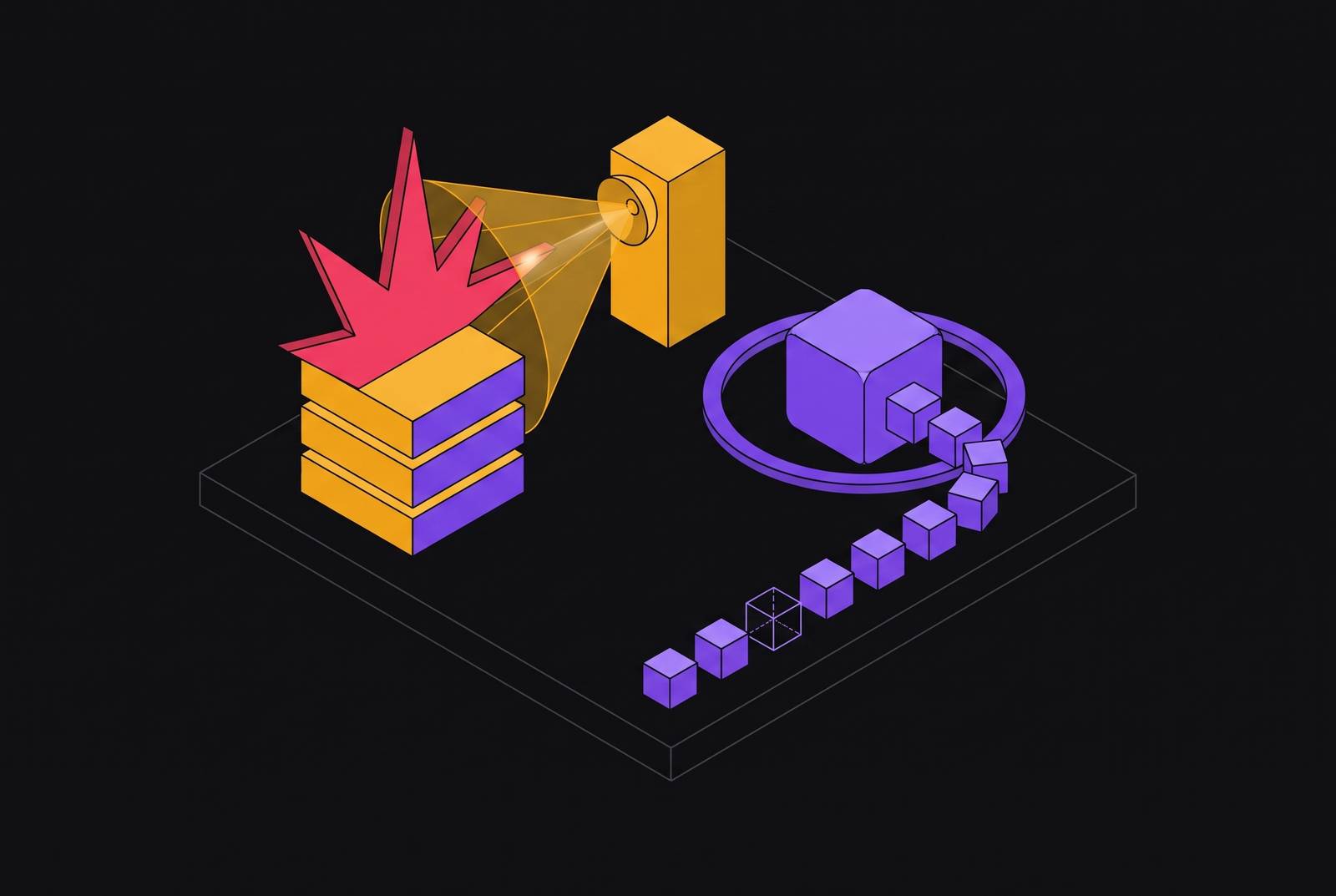
Silent failure detection for AI agents in production requires comparing what an agent did with what its instructions, evidence, and policies required. Traditional APM can report healthy infrastructure while an agent gives a fluent, wrong answer, because successful execution does not establish correctness. The gap is structural, and closing it requires trace-level evaluation of decisions and interactions.
Why traditional APM was built on a premise agents violate
An exception fires, a stack trace is emitted, an alert trips, and an engineer responds. That sequence defines the organizing premise of traditional APM. Faults produce detectable signals, and instrumentation makes those signals available for diagnosis. HTTP status codes, latency spikes, error rates, and crash reports provide different views of code paths that announce their own failure. The monitoring system can then distinguish normal execution from a departure that needs attention.
This design fits deterministic services, where the same input reliably produces the same output and a wrong result is structurally distinguishable from a right one. An agent breaks that correspondence between execution and success. It can return an HTTP 200 with a confident, fluent, wrong answer without producing a stack trace, an elevated error rate, or a latency anomaly. Every measured operation can look entirely healthy. The failure has moved into the meaning of the result, while the instrumentation still measures the machinery that produced it.
What agents actually do that deterministic services do not
Agents combine non-determinism, multi-step autonomy, and tool-mediated action. A single request can involve multiple LLM calls, tool invocations, vector lookups, and handoffs, with each step contributing to the final result. Execution success does not establish semantic success at any of those boundaries. A lookup can complete without supplying the evidence the task needs, just as a completed plan can fail to serve the user's goal. Downstream steps then inherit upstream outputs, allowing an early semantic slip to become the foundation of a confident final answer.
Raj et al. at Scale AI formalize this attribution problem in their 2026 paper, Model or Harness? An Interaction-Centric Taxonomy for Localizing Agent Failures. Agent behavior emerges from interactions among the model, harness, users, tools, memory, and environment, so an outcome-level failure label cannot reliably locate the fault. Consider an agent that ignores an earlier instruction. Context compaction in the harness may have removed it, or the model may have ignored it while it remained available. The visible failure is the same in both cases, but the repair belongs in a different component.
Non-determinism also weakens the repeatability assumption behind conventional alerts. The same prompt can lead to a different plan on each run, so it is harder to set a stable execution baseline. Liu et al., 2026 report monotonically accumulating entropy across interaction rounds even with static prompts, identical models, and fixed databases. Their work draws on what they saw in production over the long term, across more than 100,000 agent interactions. Controlled conditions did not eliminate the accumulating disorder, which challenges the assumption that unexpected behavior must originate in a changed configuration.
How do you know when an AI agent is giving wrong answers instead of crashing?
An agent can use tools in the wrong order or skip a required step while each span it executes completes normally. A loop can also repeat valid operations without getting the task any closer to being done. Detecting this class of failure requires judging the plan against the request, rather than treating the absence of execution errors as evidence that the plan worked.
Tool failures expose a related distinction between an underlying error and the agent's response to it. An agent may invoke a tool that does not exist in the runtime catalog, or fabricate a plausible answer after a tool returns a 500. In the latter case, infrastructure monitoring may detect the tool error without detecting the fabricated answer built on top of it. Reasoning failures need no underlying error at all. A factual mistake, a math error, or an ignored instruction can produce fluent output with no structural anomaly.
Silent hallucinations can affect more than the final answer. A March 2026 OpenReview paper describes internally generated false beliefs, assumptions, or intermediate representations that influence decisions without being explicitly surfaced to users. The false premise need never appear in the output. By contrast, a safety or policy violation may be plainly visible in the answer but remain invisible to a parser because its wording is grammatically and syntactically valid. Neither surface fluency nor structural validity establishes that the behavior was authorized.
Bajaj, 2026 defines evaluation blindness as a measurement function producing a value indistinguishable from a non-failing state while the system is failing, with no auxiliary signal flagging the discrepancy. The Air Canada chatbot case makes the distinction concrete. The chatbot told a passenger that a bereavement fare could be applied retroactively, although that policy did not exist, and the output passed the integration pipeline's implicit quality checks. British Columbia's Civil Resolution Tribunal found the company liable. Bajaj's analysis finds that more than half of verifiable public incidents are silent, producing zero error signals.
How the multi-step, multi-agent structure multiplies the blind spots
What Liu et al. saw over the long term shows why monitoring needs to track how deep an interaction goes. Their reported disorder accumulates across interaction rounds rather than requiring an external trigger or resource failure. Repetition is therefore not merely more exposure to isolated mistakes. It gives deviations further opportunities to influence later behavior, even when the surrounding conditions remain controlled. A view limited to the current request or final answer can miss that accumulation.
Within a multi-step trace, an incorrect intermediate result becomes the input to the next tool call. The next result can look correct on its own even though it is based on something false. Without verification between steps, each successful operation extends the chain. By step ten, the final answer may be confidently wrong without any single exception explaining its ancestry. The diagnostic task is to locate where the premise first diverged from the task.
Raj et al. organize 41 failure modes by the interaction edge where they originate, including model-to-tool, harness-to-context, and environment-to-agent. The MAST taxonomy from Cemri et al., 2025 also identifies inter-agent misalignment as a major failure category across multi-agent frameworks. At a handoff, the issue can lie in the gap between agents. Watching each agent on its own cannot show that they stayed aligned on the shared task.
Tool-poisoning via MCP illustrates another boundary that requires semantic inspection. A tool description can contain hidden instructions that take effect when an agent selects it. The agent then behaves as instructed without throwing an exception. Legitimate and poisoned tool use can both invoke a tool successfully, but their descriptions direct the agent to do different things.
Why the gap is not a configuration problem that more APM coverage can close
APM instruments what the system did, while detecting agent failure requires knowing what the agent was supposed to do. That is the central asymmetry. A standard collector does not have the agent's intent, instructions, or governing policy available as a correctness criterion. More collectors can expose more execution detail, but they cannot turn an HTTP success into evidence of factual accuracy. Threshold tuning has the same limit when the measured variable does not represent the failure.
Bajaj reports that accuracy stayed the same across multiple evaluation windows while output diversity fell by a large factor. The metric stayed reassuring while behavior degraded. This is stronger evidence than a missed exception because even an evaluation measure failed to distinguish the failing state from a healthy one. Additional APM coverage would not make the unchanged accuracy reading reveal the lost diversity. The measurement model needs a criterion sensitive to the behavior that is deteriorating.
The strongest case against this view holds that these gaps should close over time as more organizations adopt observability. A large majority of organizations have implemented some form of agent observability, yet quality issues remain the primary production barrier. Adoption alone has not resolved the mismatch. Bajaj also documents healthy-looking benchmark scores in systems failing in ways those benchmarks cannot measure.
Liu et al. argue that silent failures arise from intrinsic properties of language-based autonomous systems operating without external deterministic constraints, as well as from implementation defects. That does not make diagnosis impossible. Raj et al. find that judges who use their interaction-centric taxonomy match human fault-attribution labels far more often than chance would predict across four frontier models. The distinction becomes learnable when the interaction, rather than only its outcome, is the unit of analysis. A different monitoring model must preserve the context needed to identify both the faulty edge and the component responsible.
What a monitoring model built for semantic failure actually requires
A semantic monitoring model needs telemetry that exposes decisions in relation to the task. That includes intermediate reasoning steps, what comes of tool selection as well as tool-call success or failure, inter-agent handoffs, and per-trace scoring that checks the agent's work against its own instructions. Infrastructure metrics cannot supply those signals by inference. The purpose is not simply to collect a longer record, but to make the relevant comparison possible. Each trace must support a judgment about whether the agent followed the instructions and used the evidence available to it.
Interaction edges provide the structure for that judgment. A model-to-tool interaction needs to be distinguishable from a harness-to-context or environment-to-agent interaction, with an identifiable fault side. Otherwise, an instruction-following failure caused by context removal remains grouped with one caused by the model ignoring available context. That distinction determines where a repair belongs. Aggregate outcome metrics can report that the task failed, but they do not preserve enough structure to assign the repair.
Evaluation must run both before deployment and online. Behavioral drift can happen between model versions without a code commit, so release-only evaluations can miss the change in production. Correctness checks need to compare claims with retrieved documents or known values, since a fluent answer alone is not enough. CashBook found that a bad first AI agent session impacts retention by 15%, while the failure was invisible to engagement metrics. The example separates the user consequence from the signal needed to detect its cause.
A production-ready platform must audit traces against instructions, group deviations automatically, and surface them in the developer's existing workflow. Requiring teams to enumerate every failure mode upfront is insufficient because novel failures emerge from specific combinations of model, harness, and tool. The taxonomies already list dozens of different types of failure. Investigation must retain the interaction context that distinguishes a model post-training fix from harness engineering or environment redesign. Silent failure detection becomes actionable when an alert identifies not just an unsuccessful outcome, but the deviation, the governing requirement, and the interaction where they parted.
Sources
- Silent Failure in LLM Agent Systems: The Entropy Principle and the Inevitable Disorder of Autonomous Agents
- AI Agent Failure Modes: How Agents Break and How to Fix Them
- ”TINY” SILENT HALLUCINATIONS IN AGENTIC AI: HIDDEN FAILURE MODES IN AUTONOMOUS SYSTEMS
- Evaluation Blindness: How Silent Measurement Failures Corrupt AI Systems from Training to Deployment
- Model or Harness? An Interaction-Centric Taxonomy for Localizing Agent Failures