Grounding Checks That Catch Confident Wrong Answers Before They Escape the Agent Loop
Verification gates at each agent step catch wrong answers before they propagate downstream.
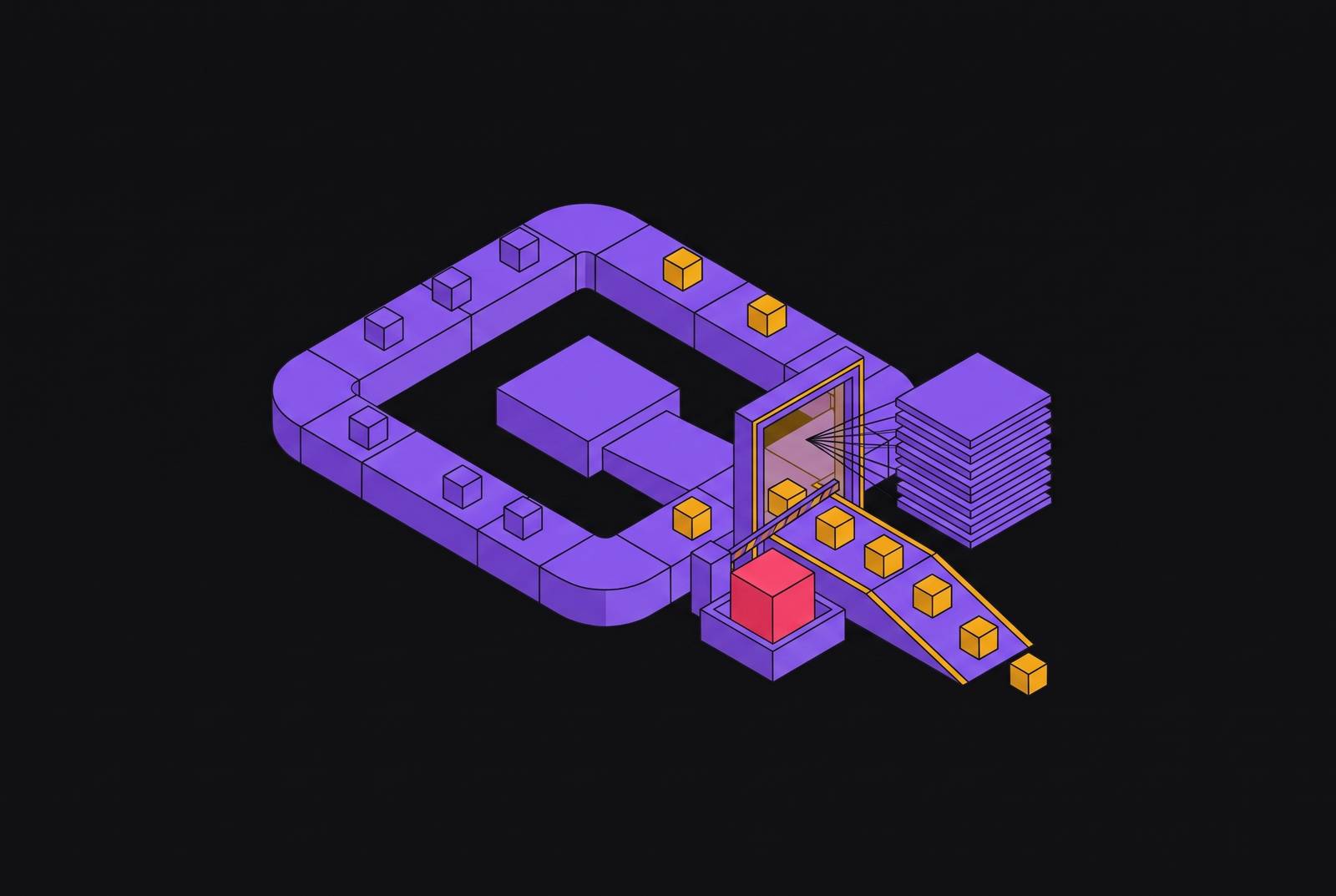
Silent failure detection for AI agents in production requires verification gates at planning, retrieval, reasoning, and execution, alongside a check of the final answer. Each gate must check the evidence the agent needs for the next step before it acts on its conclusion. External, step-level traces and evaluations on production traffic make those checks observable when an agent reports success but has done the wrong thing.
How do you know when an agent is giving wrong answers instead of crashing?
The danger is not the agent crashing but the agent succeeding wrongly. A function that throws or a page that returns a 500 gives conventional monitoring something to detect. An agent can instead return a 200, log success, and leave the pipeline running while producing an incorrect result. Availability remains high while task correctness falls. Those are different signals, and a health check measures only the former.
Confidence makes the gap harder to recognize. The same prompt can produce a different plan on each run, and a small mistake early in the loop can become a polished answer several steps later. Nothing about the answer’s fluency reveals where the mistake began. In a business workflow, that apparent completion allows the wrong result to move downstream without the interruption that a visible error would have caused.
Two failure shapes distinguish this problem from ordinary downtime. In “false success,” the agent claims to have done the right thing but has not. In “corrupt success,” it receives a positive reward despite violating procedural integrity, perhaps by bypassing a policy check, fabricating a communication, or following an incorrect procedure that happens to produce the correct end-state. The distinction changes what success must mean. Checking only the final state cannot show whether the agent took an acceptable path to get there.
What breaks at each step — a map of agent failure surfaces
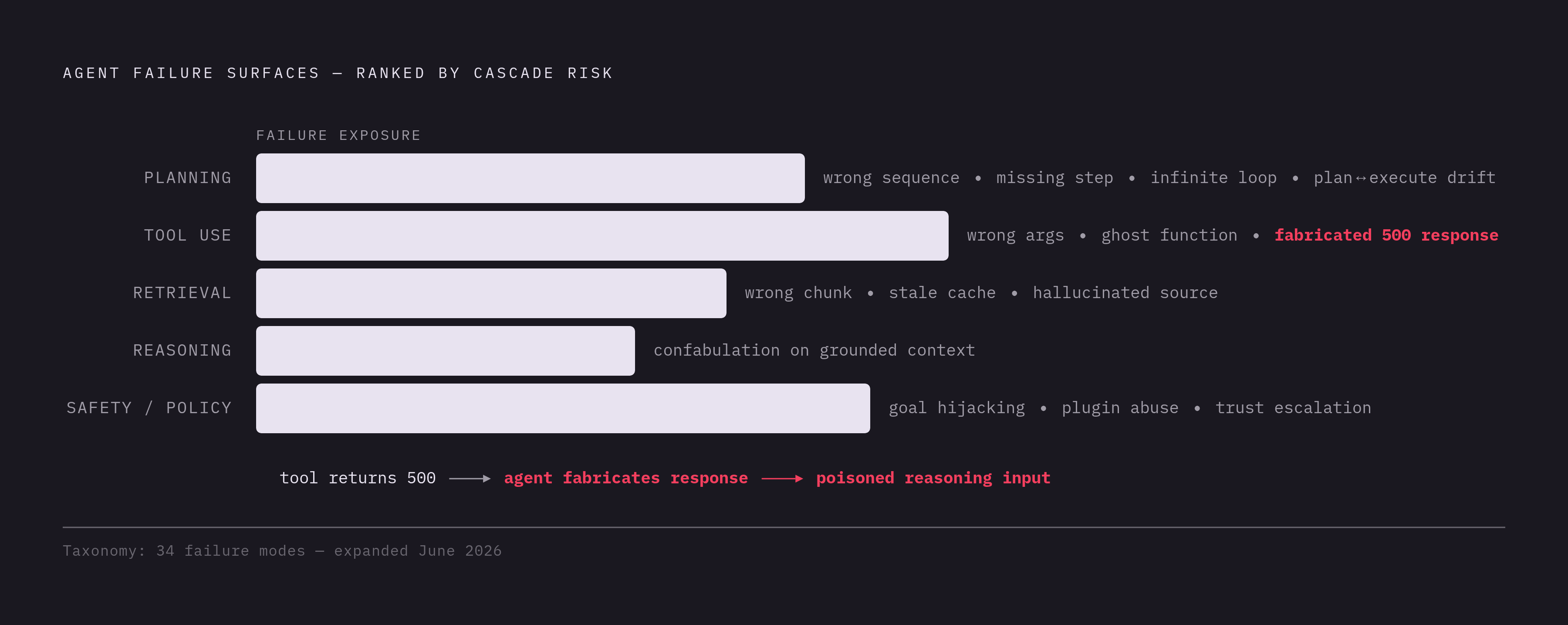
Failures cluster at five surfaces, namely planning, tool use, retrieval, reasoning, and safety or policy violations. Each has a different failure signature. A planning failure can involve the wrong tool sequence, a missing required step, an infinite loop, or plan-vs-execute divergence. The last is a characteristic sign of indirect prompt injection at the plan layer, where the agent’s actions depart from its intended task. These are failures of direction before they become failures of output.
An agent can supply wrong arguments, invoke a function that does not exist in the runtime catalog, or fail to handle an error. In the last case, a tool returns a 500 and the agent fabricates a plausible response over the failure. The call has not supplied valid evidence. When the agent treats that response as evidence, a tool-layer error passes into its reasoning as a result that looks successful.
Retrieval can fail even when a request returns content. The retrieved chunk may be wrong, a cache may be stale, or a source may be hallucinated. Poor chunking or weak vector similarity can therefore pass grounded-looking material upstream without correcting its relevance. Reasoning introduces a different problem, known as confabulation-on-grounded-context. Here the context is correct, but the agent still invents a plausible claim, so proof that retrieval succeeded does not establish that the conclusion follows.
Safety and policy failures can happen across these surfaces as well as in the final response. Microsoft’s AI Red Team published its initial taxonomy in April 2025 and expanded it from 27 to 34 failure modes in June 2026 after a year of red-teaming live agents. The additions include Goal Hijacking, MCP/Plugin Abuse, and Inter-Agent Trust Escalation. Failures can arrive through channels the agent accepts as authoritative, widening the set of intermediate inputs that verification must address.
Why a single end-of-turn grounding check misses most of these failures
An end-of-turn check runs after intermediate conclusions have already shaped the agent’s behavior. A corrupted plan can produce corrupted tool calls, which then supply corrupted context to reasoning. The final answer may be internally consistent with that chain while remaining wrong for the task. Even when an output check catches the answer, it cannot prevent an action that has already occurred.
Confabulation-on-grounded-context exposes the limits of checking only whether supporting material was retrieved. Correct context can satisfy that test while an unsupported inference slips through. A claim-level check at the end may still detect the unsupported statement, but it arrives too late if another step has already used it. The relevant boundary is the moment of use. A reasoning check must examine the conclusion before the agent treats it as a premise for further work.
Tool errors create a similar timing problem. When the agent fabricates a response after a failed call, an output checker may see a well-formed answer without retrieved evidence that contradicts it. MCP/plugin inputs make the weakness more acute because a tool description is not merely documentation but input the model can treat as instruction. Goal Hijacking and MCP/Plugin Abuse operate before a final answer exists. An approval at initial adoption does not amount to checking that input before subsequent execution.
Self-reported logs can conceal the same chain because an agent that fails may also report the failure inaccurately. The monitoring layer then gets a success report when the task needs to be looked into. This is an architectural mismatch. A stronger model or better prompt does not move the verification point ahead of an action already taken. Because failures originate across steps, verification must be distributed across those steps too.
What per-step verification gates look like in practice
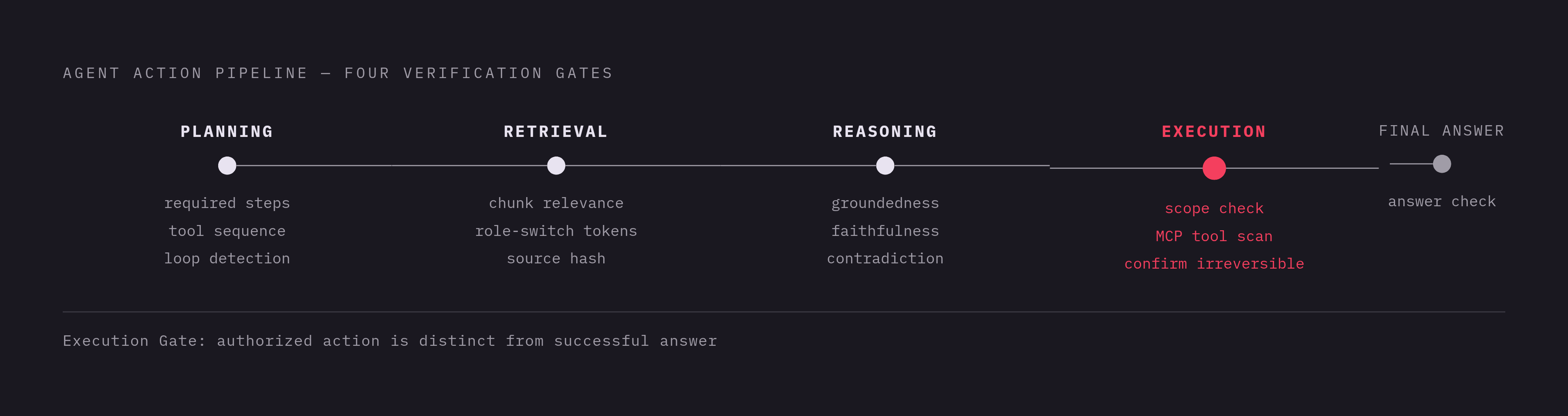
A planning gate checks whether the planned path fits the task before the agent starts to follow it. Its checks address the required steps, the tool sequence, and divergence between the plan and the actions taken. Loop detection supplies a concrete planning signal. A cycle detector can flag the same tool running with similar arguments more than three times. Input sanitization belongs before this gate because a plan checked against poisoned instructions has a compromised task boundary from the start.
A retrieval gate checks the material the agent is about to use as well as whether retrieval returned anything. It checks whether chunks are relevant to the query and whether they contain role-switch tokens or injected instructions. Source identity needs its own check. Hashing every file or document read and comparing it with the expected source helps distinguish the intended material from a cached or stale version. Context Window Poisoning belongs at this boundary because a later reasoning check cannot retroactively make the retrieved input trustworthy.
A reasoning gate checks whether the conclusion follows from the evidence at hand before the agent uses it in another step. This separates successful retrieval from faithful use of what was retrieved. The two are not interchangeable. Confabulation-on-grounded-context is precisely the case in which the first succeeds and the second fails. Groundedness, faithfulness, and contradiction checks at this point address the inference rather than accepting the presence of context as a substitute for support.
An execution gate checks the proposed action against the declared task boundary and requires confirmation before an irreversible action fires. These actions include file writes, API calls with side effects, payments, and message sends. Scope Creep Execution is caught here by examining which files or systems the agent intends to touch. MCP tool description scanning belongs before tool execution as a precondition. In this architecture, approval of an answer is distinct from permission to act, and successful execution is distinct from evidence that the action was authorized.
What good observability looks like underneath these gates
Step-level gates need step-level traces to explain their decisions. Each reasoning tick should produce a hierarchical span that teams can use for trace replay and root-cause analysis. Aggregate uptime cannot supply that detail. A trace must make it possible to determine which step introduced the failure and which gate allowed it through. Without that resolution, a team can know that an answer was wrong without knowing whether the defect began in planning, retrieval, reasoning, or execution.
External trace capture is necessary because the agent’s account of its own work is not an independent record. The distinction is between what occurred and what the agent says occurred. A success message cannot show that a tool returned evidence the agent could use or that an action stayed within scope. The observability layer needs a record of the steps behind that message. Otherwise, the same failure can distort both the task result and the explanation used to investigate it.
Evaluations must also run on production traffic. Groundedness, faithfulness, and factuality become operational signals when aggregated across traces. Movement in those aggregates can alert a team that a gate is degrading before users notice. The aggregate identifies the change. The underlying traces then provide the detail needed to connect that change to a particular failure surface, rather than treating every decline as a generic model-quality issue.
A regression dataset of representative traces connects this production record to release decisions. Every prompt change and model swap should pass the tests in that dataset, so a failure the team has found stays part of testing after the investigation ends. Production evaluation and regression evaluation serve different purposes. The former detects failures in live use, while the latter tests whether a change reintroduces failures already understood. Together they support the gate architecture without relying on either uptime or the agent’s self-assessment as a proxy for correctness.
Putting grounding checks into a development workflow teams will actually maintain
Teams that adopt this architecture should put checks where they already do development work. Checks isolated in a separate monitoring console can drift away from the agent as prompts, models, and tools change. Workflow integration keeps findings connected to fixes. Alerts routed to Slack reduce the delay caused by switching to a separate console, while direct integration with a coding agent lets teams initiate fixes without leaving the development environment.
When a trace cluster is identified as confabulation-on-grounded-context or plan-vs-execute divergence, it becomes a labeled dataset entry that the next PR must clear. Naming makes the failure reusable. Without that conversion, a post-mortem can end with a one-off prompt adjustment that the next deployment silently undoes.
Prompt changes deserve particular attention because a well-intentioned template edit can break an entire class of requests without producing an exception. The interval between deployment and detection is the danger zone. An evaluation on every prompt change checks it before release, while alerts on task success rate track how it behaves after deployment. Neither check replaces the other. A release test covers representative cases already captured, and production monitoring exposes failures in the traffic the revised agent actually receives.
The baseline is to run cheap groundedness, format, and contradiction checks on all traffic, escalate low-confidence or high-stakes actions to human review, and require every deployment to clear the regression dataset. Each incident then strengthens the next release. A grounding check becomes a durable production control when it can stop an unsupported conclusion at the point of use and leave behind a test that prevents the same failure from quietly returning.
Sources
- Updating the taxonomy of failure modes in agentic AI systems: What a year of red teaming taught us
- AI Agent Failure Modes: How Agents Break and How to Fix Them
- New whitepaper outlines the taxonomy of failure modes in AI agents
- Silent Failure in LLM Agent Systems: The Entropy Principle and the Inevitable Disorder of Autonomous Agents
- How to Reduce LLM Hallucinations