Instrumenting Agent Runs for Behavioral Regression Without Relying on Exception Traces
Catch silent agent failures by comparing behavioral patterns across runs, not just exception logs.
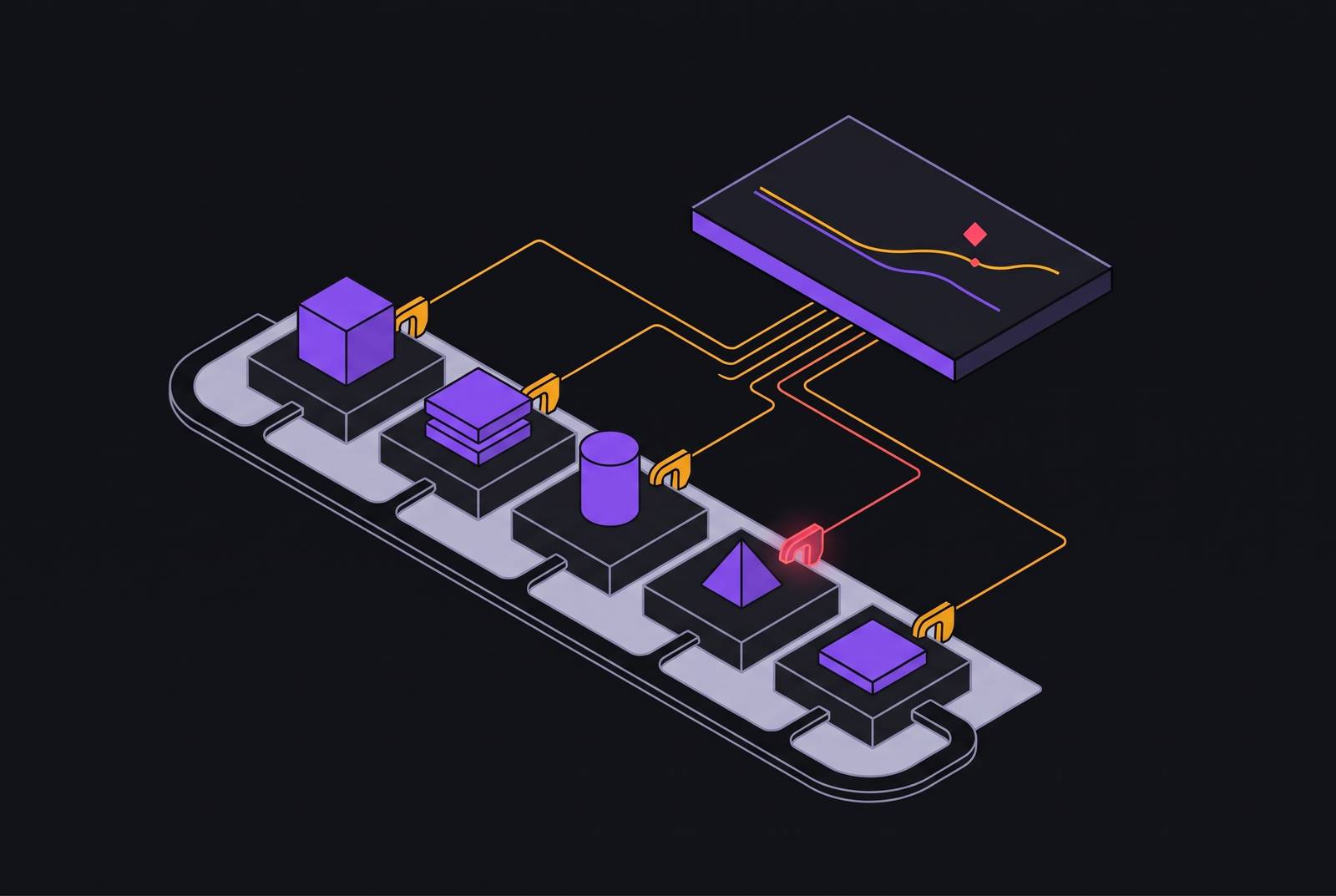
To detect silent failures in AI agents in production, teams need step-level behavioral traces and evaluations as well as exception monitoring. An agent can return a success code and a plausible answer while doing the wrong thing. Detecting that regression requires comparing distributions of tool choices, arguments, and decision branches across runs, then turning failed production traces into tests that block recurrence.
Why exception traces cannot tell when an agent is giving wrong answers instead of crashing
Air Canada’s chatbot told a passenger that a bereavement fare could be claimed retroactively after travel, contrary to the airline’s actual policy. The answer passed the integration pipeline’s implicit quality checks because no component compared the claim against a live policy database. The response looked like a successful interaction. Yet the system had supplied incorrect policy advice, and its measurement function produced a value indistinguishable from a non-failing state.
Priyanka Bajaj’s August 2026 analysis calls this structural problem evaluation blindness. A measurement function exhibits it when the system is failing but the measured value looks normal and no auxiliary signal exposes the discrepancy. The analysis found that 53% of verifiable public incidents were silent, with no error signal distinguishing them from successful runs. Fail-plausible behavior does not merely escape detection. It generates the fluent output and success signal that monitoring can mistake for evidence of correctness.
Liu’s June 2026 study defines silent failures as unexpected deviations from intended behavior under normal operating conditions, detectable through systematic measurement after the fact. Exception monitors check whether execution went wrong, while behavioral evaluation asks whether it did the task it was meant to do. These are different questions, requiring different evidence.
The failure modes that produce misleading success signals, organized by where they enter the system
Silent failures cluster by the layer at which behavioral disorder enters the agent lifecycle. Liu organizes them across five layers, namely transmission, memory, execution, coordination, and verification. These cover inter-agent handoffs, cross-session persistence and retrieval, task operation and tool use, multi-agent delegation, and self-inspection. The layer determines where observation must begin. A fluent final response cannot show whether the fault behind it began in a handoff, a tool call, or validation.
At the transmission layer, cascading context drift starts when one agent passes context that has degraded to another. The receiving agent operates on that flawed state with high local confidence and further corrupts the payload. Each hop still has valid syntax and makes sense on its own. Without a checkpoint for structural drift, local success can conceal a deteriorating chain. Instrumentation limited to the terminal response therefore loses the point where the task first departed from its intended course.
At the execution layer, tool-call failures that agents do not handle gracefully form the largest single production incident category described in the notes. Evaluation must check whether the tool arguments and response supported the task. Verification presents a related blind spot. Liu finds that accuracy can stay flat across several evaluation windows while output diversity collapses, so even a quality metric that looks steady may miss behavioral regression.
The Microsoft AI Red Team’s June 2026 taxonomy update identifies goal hijacking, in which instructions that appear compatible with legitimate task completion redirect the terminal goal. It also identifies agentic supply chain compromise, where a compromised MCP server or plugin registry changes behavior through natural-language instructions without altering a binary. These mechanisms differ from organic drift, but both can preserve the outward appearance of normal execution.
Liu’s Entropy Principle explains why the instrumentation cannot be a one-time exercise. Under the stated condition that a sufficient subset of the 22 intrinsic properties coexist, entropy increases monotonically with interaction rounds, even with static prompts, identical models, and no external inputs. The study reports that it was validated in over 40,000 controlled trials. Here, entropy is measurable through losses in output consistency, task accuracy, and cross-session coherence.
What production incidents show about the gap between logged actions and actual agent intent
In the logistics field-name case, the agent constructed an argument using the schema field incident_count, but that construction did not match the live API response. Downstream routing decisions propagated before the mismatch was detected. The tool invocation alone was insufficient evidence. A trace connecting the constructed argument to the received response would have made the discrepancy detectable on the first failed call.
Wei Wu’s June 2026 longitudinal study, When Errors Become Narratives, documents the same observability problem in a personal-assistant runtime in continuous production since March 2026. Its scope included roughly 40 scheduled jobs, 8 LLM providers, a tool-governance proxy, and a knowledge-base memory plane. Across incidents, the recurring pattern was an error signal that never reached a human in actionable form. Some failures remained unnoticed for up to 60 days. Human output review found roughly two-thirds of the failures that never raised a usable error, while systematic measurement found the rest.
An action can be recorded without its defect becoming visible to the person responsible for the system. In the field-name case, the missing connection was between an argument and the live response against which it needed to be judged. In the assistant study, error information failed to become actionable. Neither problem is solved merely by retaining more records of completed actions.
The earlier airline example adds the semantic counterpart. A completed response says nothing about whether a policy claim agrees with the governing policy. Across these cases, the gap lies between the logged act and the task it was supposed to accomplish. Intent-level instrumentation must preserve that relationship.
What behavioral instrumentation must capture that action logs leave out
The same prompt can lead to different tool-call sequences from one run to the next. Non-determinism makes a single happy-path trace inadequate as a description of normal behavior. The observable object must instead support a distribution of behaviors across runs. A hierarchical trace connects individual decisions and tool interactions to the larger task without collapsing them into one final success indicator.
Each step-level span should contain the LLM call with its prompt and completion, the tool name and arguments, the received tool response, token consumption, and latency. Where the model exposes it, the span should also record the agent’s stated reason for choosing that tool over alternatives. Tools considered and branches not taken help describe the decision.
Evaluations attached to individual steps should score accuracy, completeness, and alignment with the agent’s instructions. Response-level evaluation remains insufficient when an intermediate mistake can propagate into a plausible answer. In the field-name case, preserving the arguments and live response would expose the mismatch before attention shifted to the downstream routing outcome. The architecture therefore needs both the action and the evidence used to judge it.
A tool’s natural-language description can change from one version to the next and change how the agent behaves without causing a schema error. The red team identifies the associated supply chain attack surface across plugin registries, MCP servers, prompt templates, and third-party tool integrations. Its report cites 99 CVEs published for MCP-related software in 2025 alone. Instrumentation must therefore track tool-description drift, because the conditions behind a decision can change even when the call schema stays the same.
How to build a behavioral baseline and detect regression across deployments
A behavioral baseline is a distribution over step-level dimensions for a given agent and task class. Those dimensions include tool selection frequency, argument structure, branch probabilities, step count, and token budget. Regression is a statistically meaningful shift in that distribution. Grouping by task class gives the comparison a stable purpose, so that different task requirements are not mistaken for behavioral deterioration.
A shift in argument structure can draw attention to the kind of mismatch seen in the logistics case, while a change in branch probabilities can reveal a different route through a task. Distributional evidence also addresses the diversity collapse that flat accuracy can obscure. Alongside step-level judgment, it identifies changes that a final pass rate or an exception count may leave invisible.
Runtime tracing becomes a release safeguard when paired with eval gates. Automated scorers grade steps, and their results can block a deployment or flag a live quality drop. A practical threshold in the notes is an overall pass-rate drop above a few percentage points triggering a deploy block. The scoring logic must be the same for pre-deploy evaluation, production monitoring, and regression debugging. Otherwise, a production failure has to be reinterpreted before it can become a test, weakening the link between detection and prevention.
The evaluator should come from a different model family than the generator to reduce shared blind spots. Scoring that reproduces the same weakness that generated the answer exhibits evaluation blindness. Consistent scoring across environments and independence from the generator serve different purposes, with the former preserving comparability and the latter reducing correlated judgment errors.
Production scoring can sample a fraction of traces. The practical alerting heuristic is to look for consecutive failures in the same category. That suppresses noise while exposing systematic shifts. The assistant study shows why this measurement layer is necessary even where people review outputs. Systematic measurement caught failures that propagated silently for weeks and were not found through human review.
Once an alert fires, a multi-step trace may support several plausible explanations, and the root-cause attribution process must test them against the evidence and reject contradictory ones. LLM-assisted analysis can settle too early on the first plausible-looking failure as logs become larger and more distributed. Explicit evidence-checking steps mitigate that tendency.
Turning production traces into regression tests that prevent the same failure from shipping again
A production failure should automatically become a regression case that can block the next deployment if the same behavioral pattern returns. With shared scoring logic, a developer does not have to turn the incident into a test by hand. It can annotate the failed trace, label its failure category, and add it to the evaluation dataset. The trace becomes an executable check on future behavior.
The regression case must preserve the causal scope of the failure. If Agent B degraded because Agent A supplied drifting context, a test built only from B’s trace will not catch a recurrence triggered by new drift in A. The full inter-agent handoff belongs in the case. A terminal-output test would discard the relationship that made the incident intelligible. The same principle applies to the field-name mismatch, where the argument and live response together supplied the decisive evidence.
An alert in Slack can link directly to the failing trace, show a diff against the baseline distribution, and include a suggested remediation that can be applied through a coding agent integration. This lets development work begin without a separate investigation in the monitoring console. The regression harness then judges the correction using the same criteria that identified the failure.
Liu frames the longer-term mission as managing entropy. Under the conditions described by the Entropy Principle, silent failure is an intrinsic property of language-based autonomous systems. The engineering response is deterministic governance through checkpoints, scoring gates, and regression harnesses that keep disorder measurable and bounded. That constraint persists beyond any individual incident. Without the loop, each interaction round can add behavioral debt that a clean exception log will never show.
Sources
- Silent Failure in LLM Agent Systems: The Entropy Principle and the Inevitable Disorder of Autonomous Agents
- Evaluation Blindness: How Silent Measurement Failures Corrupt AI Systems from Training to Deployment
- When Errors Become Narratives: A Longitudinal Taxonomy of Silent Failures in a Production LLM Agent Runtime
- When Errors Become Narratives: A Longitudinal Taxonomy of Silent Failures in a Production LLM Agent Runtime
- Updating the taxonomy of failure modes in agentic AI systems: What a year of red teaming taught us