Retry Loop Taxonomies in Production AI Agents
Structurally different loop failures need different fixes, not one catch-all patch.
Pull the trace on a looping agent: the first thing you notice is what's missing. No exception. No timeout. Latency looks normal, tool calls return success codes, and yet the agent has been running for forty turns without finishing the task. That absence of an obvious error signal is the actual problem: engineers scanning for a single, recognizable "loop bug" end up grouping three structurally different failures under one label, then patch whichever surface is closest at hand. Exact repetition, context rot, and goal-drift cycling all produce the same symptom in a dashboard, a trace that keeps running past where it should have stopped, but they have different causes, different detection signals, and different fixes. Treating them as one category sends the patch to the wrong layer almost every time; the engineering hours get spent and the agent keeps looping anyway.
The agent loop's architecture creates the conditions for all three loop types
An agent loop runs on a simple cycle: perceive, plan, act, observe, and then the observation becomes the next perception. That last step is where all three failure types trace back to, because the architecture has no built-in checkpoint that verifies the thing being fed back in is still accurate. Whatever gets written into the observation, whether it's a tool's error message, a growing block of accumulated context, or a plan the agent quietly revised mid-task, carries forward into the next turn's reasoning without anything checking it on the way in.
The perceive step does the real work here. What the agent reads at the start of a turn sets what it reasons about, what it decides to act on, and what it reports back as having happened. If that input is wrong, incomplete, or stale, nothing downstream catches it, because the planner and the executor both trust the perception they're handed. A broken perceive step doesn't announce itself; it just quietly steers every decision that follows.
Plan-and-execute and ReAct architectures handle the timing of planning differently. Atlan describes plan-and-execute agents as writing out a full plan before acting, while ReAct agents interleave reasoning and action turn by turn. But the distinction in timing doesn't change the underlying weakness: neither architecture requires proof that the previous step actually moved the task forward before starting the next one. A turn can run, produce an output, and feed into the next cycle with no check on whether real progress happened.
The deepest structural gap sits at the exit. Atlan's description of the agent loop points to the absence of an explicit stopping condition, goal satisfied, iteration cap hit, human handoff triggered, as the direct precursor to looping behavior. Without one of those conditions written in and enforced from outside the loop, the agent has no internal reason to stop. Repetition is the default behavior of a system with no instruction to do otherwise, so "it's looping" by itself tells an engineer nothing about where the actual problem sits.
Loop type one: exact repetition
Exact repetition is the most recognizable of the three, and also the easiest to misread as a tooling bug when it is actually a perception failure. The pattern in the trace: the same tool gets called turn after turn with the same or nearly identical arguments, and the observation field attached to each call shows no change in state between iterations. Step count climbs. Token usage climbs. But nothing new has entered what the agent is perceiving.
The cause sits upstream of the repetition itself. A tool call fails, maybe it throws a malformed response, maybe it returns an error code, and that failure never gets translated into something the agent's next perceive step can read as "this didn't work." The Taskade error recovery guide describes a specific version of this: a tool returns a 500, the agent fabricates a plausible-sounding response on top of the failure, and proceeds as though the call succeeded. Because the agent's internal state never updates to reflect that something broke, its next move is to try the same thing again, often with the exact same argument shape that failed the first time. The agent isn't being stubborn. It genuinely has no signal that the first attempt was wrong.
A related version compounds the same problem: the agent retries with arguments that don't match what the tool's schema expects because nothing told it the argument shape was the issue. All it knows is the call didn't return the result it expected, so it tries again the same way.
The detection signal for this type is concrete and checkable: the same tool, called with similar arguments, firing more than three times within a single trace. The FutureAGI taxonomy sets that threshold, three or more, as the cycle detector boundary for this subtype, precisely because high argument similarity across consecutive turns combined with a flat observation state is close to a unique fingerprint for exact repetition. It doesn't look like context rot, where the arguments would vary, and it doesn't look like goal-drift, where the agent would still be changing its approach even if its target has moved.
The fix for this type sits at the tool layer, not the planner. The failure needs to be made explicit in the observation the agent receives, a structured error payload rather than a silent 500 or a vague non-answer, so the agent has something concrete to reason about on the next turn. Paired with a cycle detector tuned to the argument-similarity threshold, that closes the loop at the point where it actually opens: the moment the first failure goes unreported.
Loop type two: context rot
Context rot is harder to catch because it doesn't look like a stall. The agent keeps producing new tool calls, new arguments, new outputs that look like progress on the surface. What's missing is movement toward the goal itself. The task is not meaningfully closer to done after twenty additional turns than it was before them, even though the agent has been active the entire time.
The mechanism builds up gradually over many turns. Every turn through the loop appends more material to the context the agent is carrying, prior tool outputs, intermediate reasoning, partial results, and none of it gets pruned or checked against what the task actually requires. Atlan's description of the agent loop names the structural cause directly: the observation from one turn becomes the perception for the next, with no validation step confirming that the accumulated context still accurately represents where the task stands. As that context grows, the signal the agent needs to reason well gets diluted by everything else sitting alongside it, and the quality of its reasoning degrades turn over turn even though nothing has technically failed.
This is the key distinction from exact repetition. In exact repetition, the observation state doesn't change between turns, the agent is reading the same thing and doing the same thing. In context rot, the observation state changes constantly, it's just changing in a direction that moves the agent further from a clean read on the task, not closer to one. A detector built to catch argument-similar repetition will see novelty in every turn and report nothing wrong, because nothing about context rot resembles repeated identical calls.
The detector has to track goal-state advancement directly, not output variety. Token usage per turn rises as the context keeps growing, while whatever metric tracks progress toward the goal flatlines or declines. That combination, rising cost per turn paired with stalled progress, is what marks context rot apart from an agent that's simply taking a long route to a correct answer.
The fix runs through context management, not error handling. That can mean active pruning or summarization of the context between turns so stale material doesn't keep accumulating, an external reference the perceive step can check against to confirm the task state it's building on is still accurate, or a hard iteration budget that forces a structured checkpoint before the context degrades past a recoverable point. None of those are tool-layer fixes, and none of them touch the planner's termination logic. They fix what's actually broken: what the agent is reading at the start of each turn.
Loop type three: goal-drift cycling
Goal-drift cycling is the most structurally distinct of the three because nothing upstream of the planner is broken. The tool calls can succeed cleanly. The context can stay well-managed. What's gone wrong is the agent's internal representation of what "done" actually means, and that drift happens quietly enough that the agent keeps acting with full confidence the entire time.
The mechanism plays out over the course of a long, multi-step task. Intermediate tool results, retrieved context, or instructions injected along the way can update the agent's plan-side goal representation in small increments, and each increment shifts what counts as task completion without the agent registering that the target moved. The agent keeps working, and from its own perspective, it's making consistent progress toward a goal. The goal just isn't the one it started with.
The FutureAGI taxonomy names the clearest fingerprint of this: the planner set one sequence and one termination condition, and the executor is carrying out a different one. A prompt injection targeting the plan is one way that divergence gets produced, not the definition of the failure itself, and it's the canonical signal of indirect prompt injection or goal corruption happening specifically at the plan layer.
Research on agent behavior frames why this failure is structurally built into how these systems operate. A paper on entropy in language-based autonomous systems (arXiv:2606.08162) states that such systems, running without external deterministic constraints, experience a monotonic increase in entropy as interaction rounds continue. Agent trajectories aren't fixed in advance; they get decided dynamically, turn by turn. Goal-drift cycling is what happens when nothing outside the loop holds the stopping condition fixed, so it drifts along with the dynamic trajectory. If nothing anchors "done" externally, "done" is free to drift along with everything else the agent is reasoning about.
The contrast with context rot gives the taxonomy its practical use. In context rot, the agent loses track of where it currently stands, its read on the present state of the task degrades. In goal-drift cycling, the agent has a perfectly clear read on where it stands; the destination itself has moved. Confusing the two means engineers fix the wrong one.
Detection here looks at the gap between the goal the plan span emitted and the goal the executor is currently optimizing toward. A second signal: across several consecutive steps, a goal-evaluation score stays flat even as the agent reports progress. A third: the agent reaches a stopping condition that was established earlier in the task and keeps going past it anyway.
The fix belongs to the planner, not the tool layer or the context pipeline. Termination conditions need to be held externally and immutably, in a way the planner itself cannot quietly overwrite mid-task. If a plan-versus-execute evaluator scores divergence on every turn, it catches the drift before it compounds, and a goal-progress evaluation that doesn't rely on the agent's own self-report closes the loophole that lets the agent believe it's still on track when it isn't.
What separate detectors for the three types measure
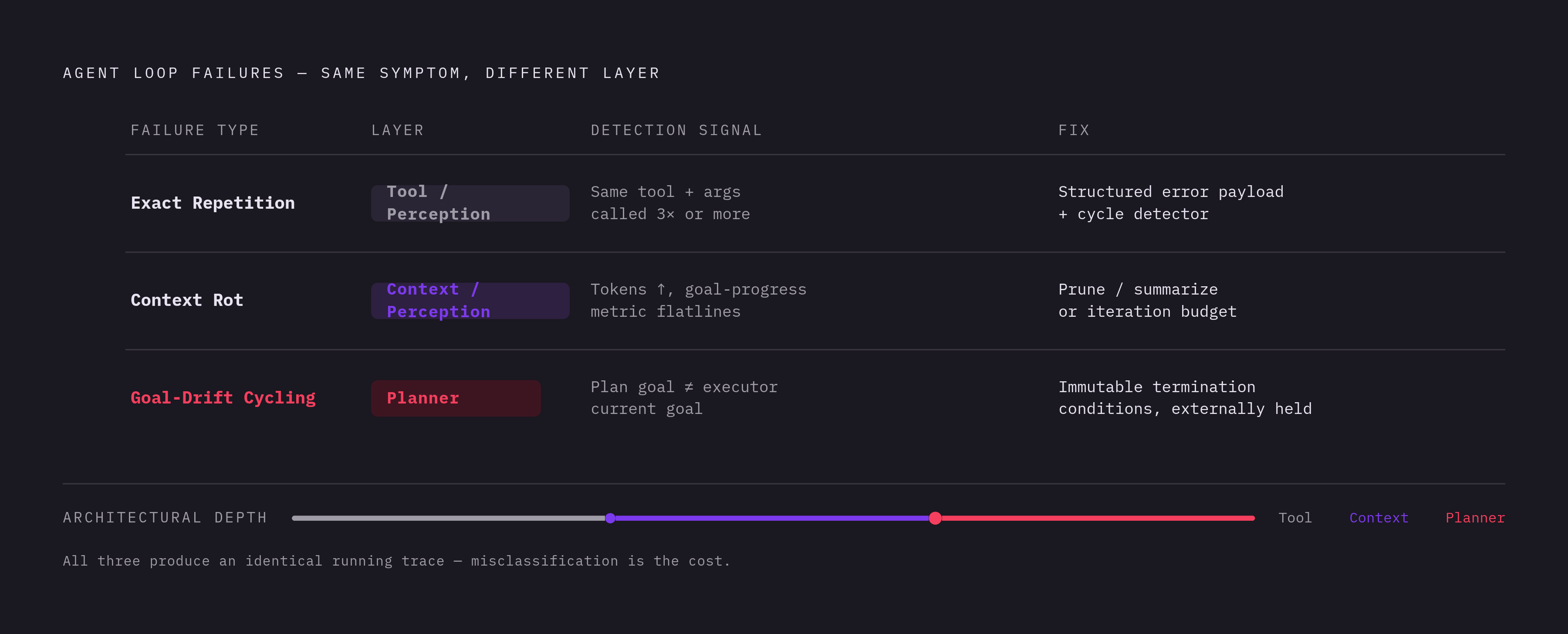
A single threshold on step count or token usage will flag all three of these failure types and tell you nothing about which one you're looking at. That's the practical argument for building three distinct detectors rather than one generalized "loop alarm": each type leaves a different signature in the trace, and collapsing them into one metric erases exactly the information needed to fix the problem.
Exact repetition's detector measures tool-call and argument similarity across consecutive turns, with the FutureAGI threshold of three or more similar calls marking the boundary worth alerting on.
Context rot's detector has to measure goal-state advancement per turn, not output novelty. Its signature is token usage climbing while a goal-progress metric stays flat, and catching that needs a goal-progress evaluation that runs alongside the trace, independent of whatever the agent itself reports about its own status.
Goal-drift cycling's detector measures the divergence between the plan span's stated goal and the goal the executor is currently working toward. Capturing both as separate, directly comparable fields in the trace matters because the whole failure is defined by a gap between the two that wouldn't show up in token counts or call frequency.
None of these three measurements substitute for each other, which is the point. The measurement has to happen from outside the agent's own reasoning. Self-reported logs are not reliable here, because an agent that's failed usually fails to log that failure accurately in the first place, it's reasoning from a corrupted or incomplete picture of its own state, so asking it to self-report on that same state produces the same error twice. Capturing tool-call results and goal-progress externally, independent of what the agent believes happened, is the only way to see the loop from outside it rather than through the same lens that's already distorted.
The cost of misclassification: what happens when the wrong fix is applied
Applying the wrong fix to a loop doesn't fail safely. It leaves the root cause untouched, burns engineering time, and produces false confidence that the problem has been handled, right up until the same loop recurs in production weeks later.
A cycle detector tuned for exact repetition, built around an argument-similarity threshold, misses context rot. Context rot produces varied outputs by definition, so the detector sees novelty turn after turn and reports a clean trace while the agent's actual goal progress stalls for dozens of turns.
Adding context pruning to a trace that looks like context rot but is actually goal-drift cycling won't help either. The goal representation has already been corrupted at the plan layer, and shortening or cleaning the context does nothing to restore a termination condition the planner has already overwritten. The agent will keep working cleanly, efficiently, and toward the wrong finish line.
The cost of missing these distinctions isn't abstract. The Taskade error recovery guide describes the compounding dynamic directly: an autonomous agent running an agentic loop compounds a single unhandled error across every subsequent step, and per-call rate limits fail to contain that kind of compounding because the failure happens above the rate-limit layer.
The gap behind all of this is one of trace granularity. MLflow's 2026 production monitoring guide and Mastra's observability guide both push teams toward deep, span-level tracing and evaluation rather than basic agent monitoring, and the reason is straightforward: a team can observe that something looped without having anywhere near enough detail in the trace to say which of the three it was. Classification is the step that decides whether the fix that follows actually reaches the failure or lands somewhere beside it.