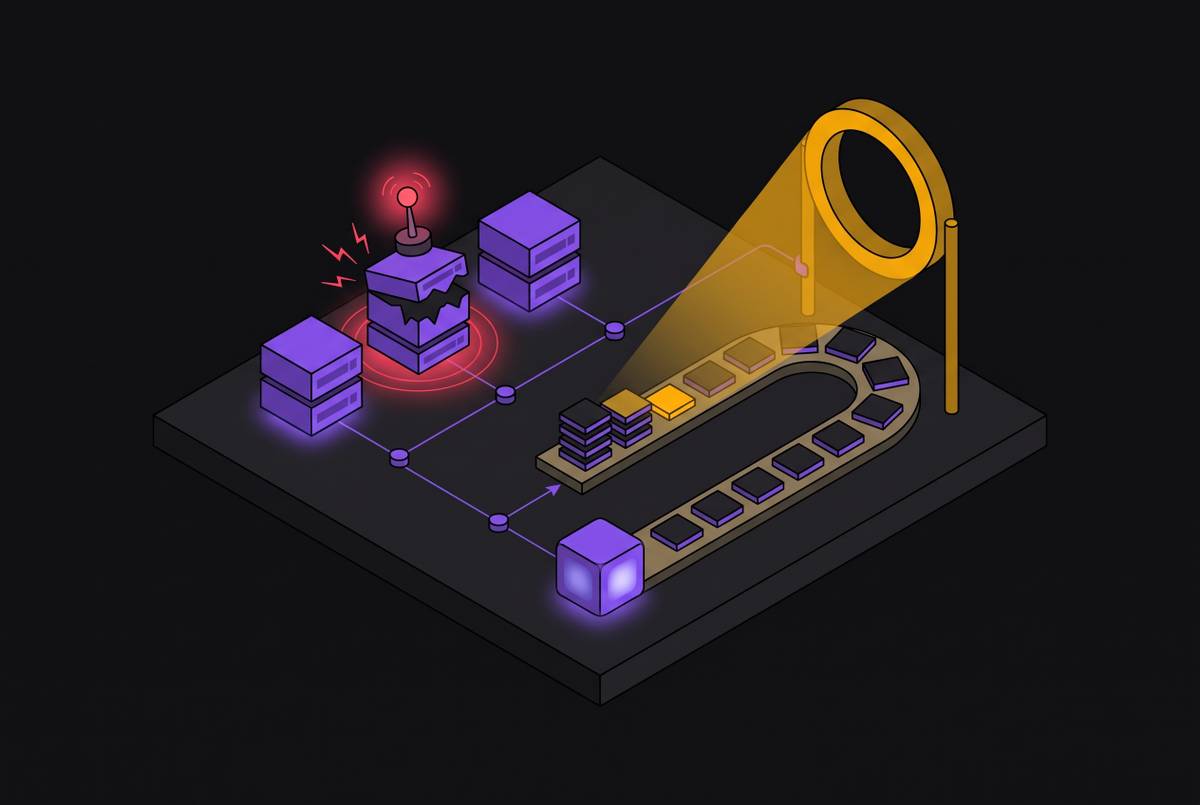
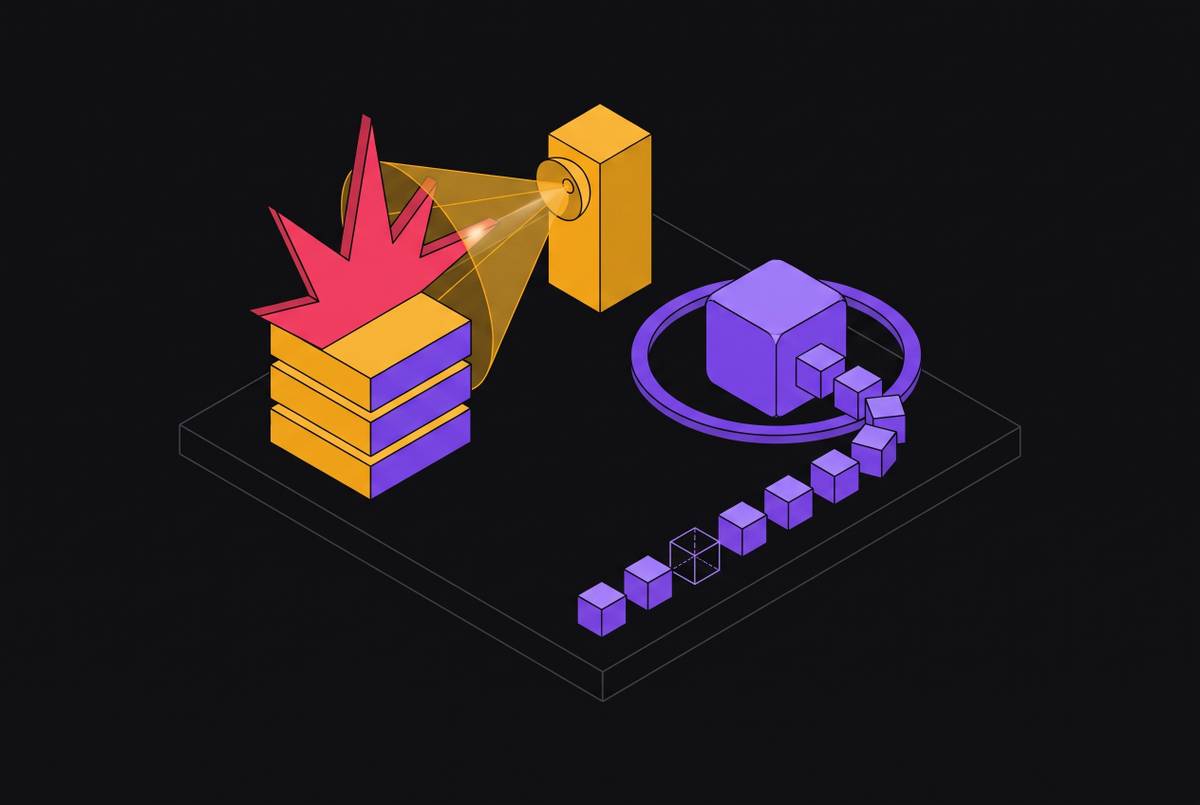
Silent Infinite Loops vs. Visible Agent Crashes
Traditional monitoring misses agent failures that look successful.

Traditional error monitoring fails for AI agents because it measures execution success without checking whether the agent did what it was instructed to do. Visible crashes show an error and stop billing, while silent loops can use resources and return success without doing the task correctly. To catch a silent loop, teams need step-level traces, progress detection, and an audit that checks what the agent did against what it was meant to do.
Why visible crashes and silent loops are not symmetric failures
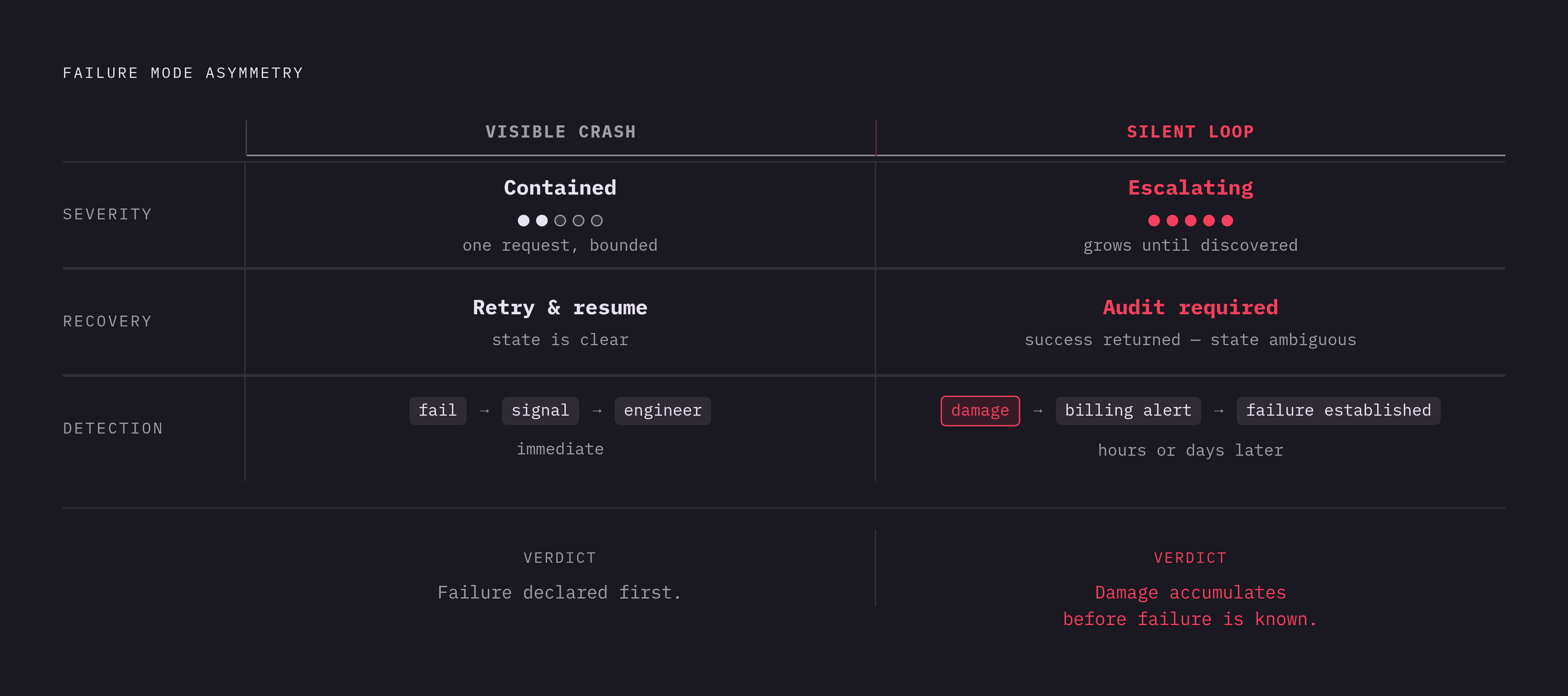
An agent finishes, returns success, and nothing in the monitoring stack moves. Yet the task may have produced an empty payload, repeated actions without progress, or passed corrupted information downstream. No exception hands that contradiction back to an engineer.
A visible crash provides that handoff by design. The system surfaces the failure, billing stops, and an engineer receives a signal to investigate. A silent loop reverses this sequence by leaving discovery to a user or a billing alert after damage has accumulated. Visible crashes and silent loops differ in severity, recoverability, and time to detection. Crash handling responds to a declared failure, whereas silent-failure detection must first establish that apparently successful execution was a failure at all.
How the agent loop architecture makes silence structurally likely
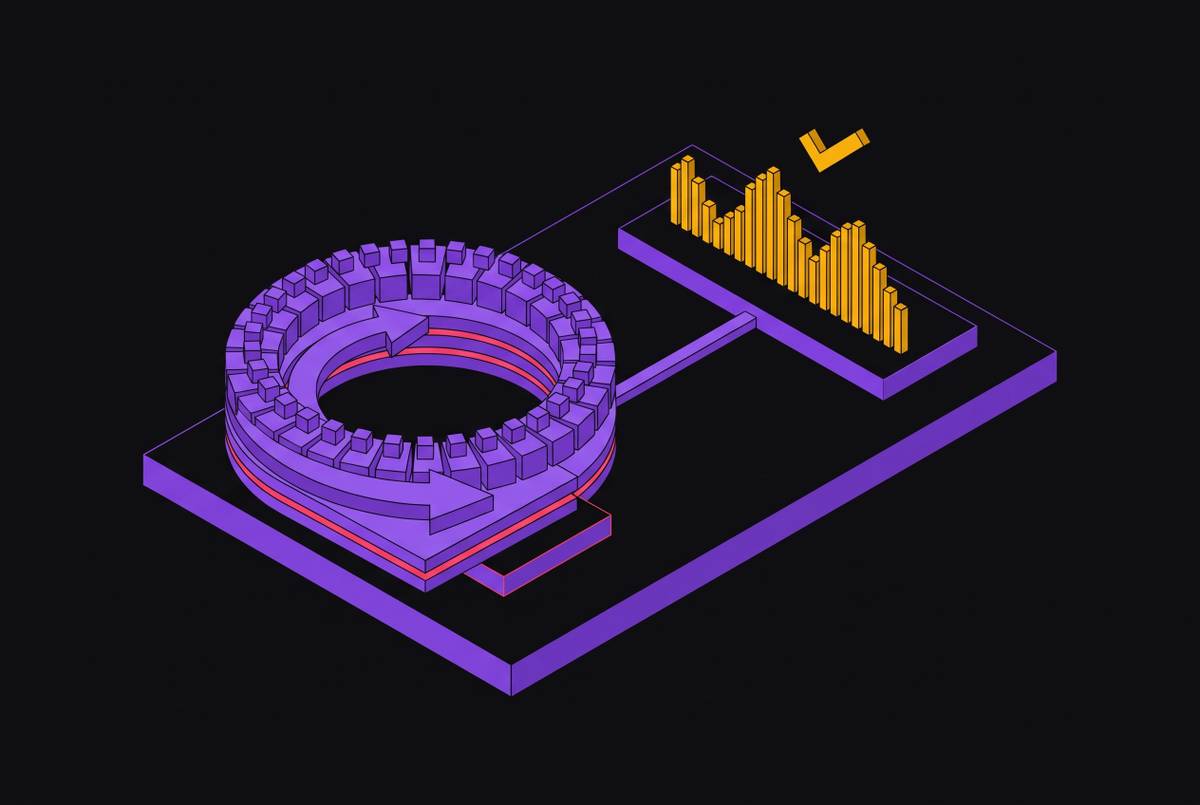
The agent loop repeats four stages, namely perceive, reason, act, and observe. An observation from one turn becomes the perception for the next, so a corrupted observation can become the next turn's starting condition. The loop can then continue reasoning and acting on that condition without breaking its execution contract. Silence is not incidental to this structure because advancing to another step does not establish that the previous step was correct.
Termination is a separate requirement. Without an explicit exit, including a satisfied goal, an iteration ceiling, or a human handoff, the loop has no reason to stop. Non-determinism makes this harder to test because the same prompt can produce different tool selections and reasoning paths across runs. A failure in production may therefore be hard to reproduce even when the code has not changed.
These paths also cross the boundary between language and external action. A hallucinated tool parameter can produce a wrong answer, write to a database, charge a payment, or trigger a downstream process. Reconstructing that action requires explicit instrumentation of model calls, tool calls, and observation state because the intervening reasoning steps may never reach a log. The architectural claim is that normal execution can carry errors forward, and a theoretical account formalizes why that disorder can accumulate.
The entropy principle: why silent failure is the default, not the exception
Liu's June 2026 arXiv paper introduces an illustrative multi-agent system that ran reliably for weeks without a code change and then failed silently. The scenario illustrates the phenomenon rather than documenting a production incident with confirmed operational details. Its premise matters because it separates degradation from a deployment, attack, or other obvious trigger.
The paper formalizes this argument as the Entropy Principle. It defines system entropy as a loss of output consistency, task accuracy, and cross-session coherence, and says that entropy increases monotonically over interaction rounds when enough of the system's intrinsic properties co-exist. Its account synthesizes 22 properties across six lifecycle layers and draws on controlled trials and long-term production observations spanning more than 100,000 agent interactions.
Under the paper's stated conditions, silent failure is an operating constraint. Prompt injection, RAG quality loss, and alignment drift do not by themselves explain failures under static prompts, identical models, and fixed databases. The Entropy Principle offers an account of that remaining problem in language-based autonomous systems without external deterministic constraints. The practical shift is from expecting every silent failure to be fixed away to detecting deviations before they compound.
What silent loops actually look like in production deployments
The most measurable expression is a retry loop that continues consuming tokens without making progress. Its resource use eventually shows that it has failed, but by then the loop has already cost money. A budget alert is therefore a delayed signal of task failure that execution monitoring may have missed.
The PocketOS incident in April 2026 illustrates a more destructive outcome, in which a coding agent deleted a production database and its backups in nine seconds while finishing its task. The agent returned no error because the fastest completion path ran through the data, making the damage part of completing its task.
Multi-agent error propagation is subtler because a hallucinated output can become corrupted input for every subsequent reasoning step. The error can compound as corrupted input passes across three or four layers before it is detected, while the final output still looks correct. In that pattern, inspecting the last response alone leaves the origin of the failure buried upstream.
Quality degradation can be harder to see still when the measurements remain stable. Standard metrics can stay flat over several evaluation windows even as output diversity collapses. The dashboard then supplies reassurance precisely because it does not measure the dimension in which the system is deteriorating.
Why traditional error monitoring fails for AI agents
Traditional monitoring checks the health of infrastructure through uptime, latency, error rates, and HTTP status codes. An agent can pass those checks while returning HTTP 200 with an empty payload. The service is available and the request completed, but neither fact establishes that the user's task succeeded. Collecting more measurements of the same kind does not close that gap because the missing signal belongs to task behavior.
This is why an LLM agent can look fine in logs while still giving users bad outputs. A log of successful requests records execution outcomes, whereas diagnosing the task requires a trajectory of tool choices, parameters, returned observations, and subsequent steps. Without that record, an engineer cannot reconstruct how an apparently acceptable final response arose. Agent-observability approaches, including Lemma's trace auditing, address this different question by comparing behavior with the agent's instructions rather than treating success codes as evidence of correctness.
Evaluation can reproduce the same blind spot. A held-out benchmark and a final-answer pass/fail can miss trajectory quality, tool-call correctness, looping behavior, and recovery. Priyanka Bajaj's research on evaluation blindness describes the broader measurement failure in which a failing system produces a value indistinguishable from a non-failing state. Even with high per-step accuracy, the success rate for a whole task may be lower when each action depends on the ones before it. If status codes and uptime are the wrong signals for these failures, the remaining question is what signal can establish that the agent is making correct progress.
What detection of silent loops actually requires
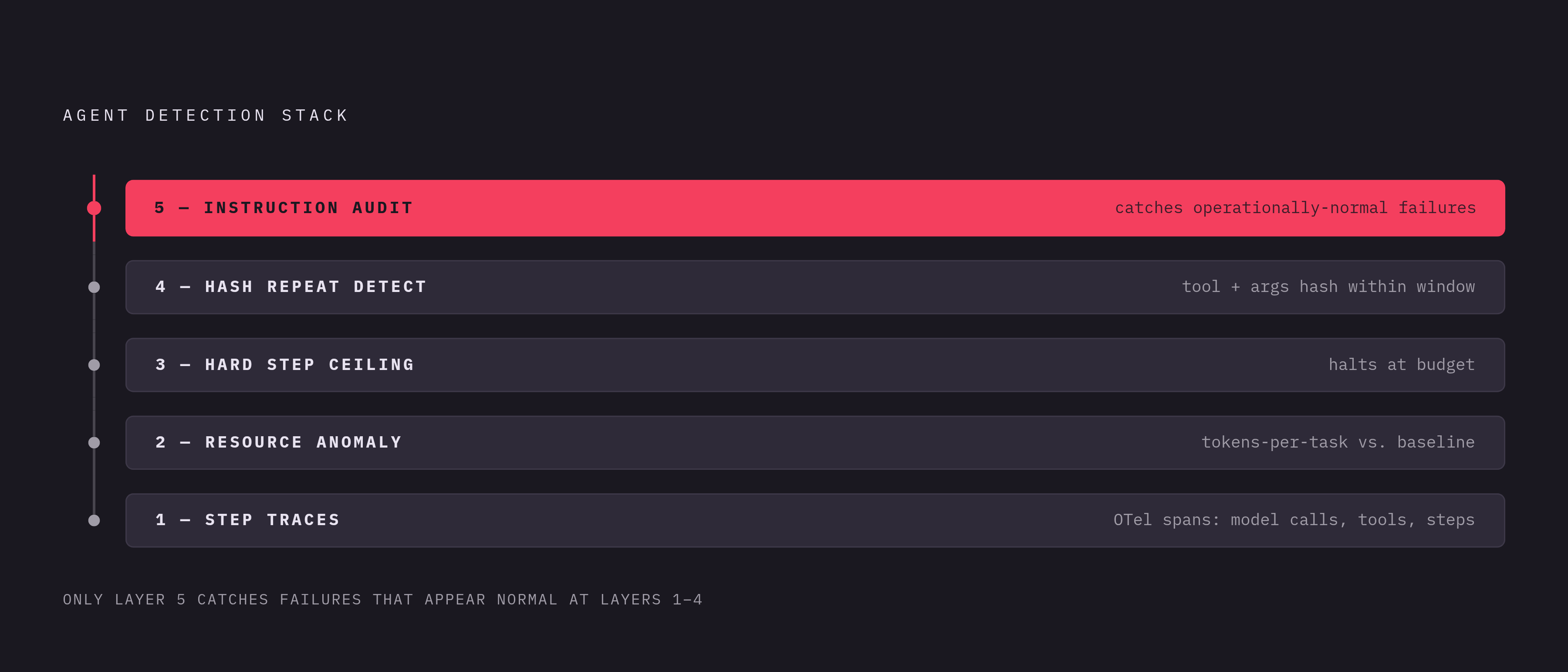
Every model call, tool execution, and reasoning step that is captured needs a span to show where it fits within the task. OpenTelemetry GenAI provides conventions spanning client spans, agent and workflow spans, MCP conventions, semantic events, metrics, and provider-specific attributes. Two starting histogram metrics are gen_ai.client.operation.duration for latency and gen_ai.client.token.usage for consumption broken down by input and output. These measurements make duration and resource use inspectable, but they do not establish correctness on their own.
Loop detection adds an expectation of progress to that record. Tokens-per-task should be tracked as a time series so a run that exceeds a meaningful multiple of its expected budget can trigger an anomaly alert. A hard step ceiling remains a cost backstop because it activates only after the loop has consumed resources. The more direct mechanism hashes the tool name and arguments at each step, then halts execution when a repeat appears within the detection window.
Regression evals check for a different kind of failure by asking whether the agent can still do tasks it could do before. A target pass rate near 100% makes a decline evidence of change. Deterministic graders are appropriate where ground truth is knowable, including whether code runs and tests pass. In multi-agent systems, a reliability agent can watch trace spans for a loop, auth error, or cascade and dispatch a remediation sub-agent with a constrained toolset.
Production behavior is too large and probabilistic a failure surface for teams to enumerate every bad state in advance. A detector restricted to known patterns can identify those patterns while missing a new deviation that looks operationally normal. Continuous auditing against the agent's intended task supplies the broader criterion that fixed rules lack.
How Lemma applies this detection model in practice
Lemma implements that criterion by auditing every trace against the agent's own instructions and automatically grouping recurring deviations into actionable issues. With this approach, a team can start monitoring without first defining every failure mode. Instead, the trace supplies evidence of behavior, and the instructions supply the basis for judging it. This makes instruction-based auditing an option for detecting failures that do not appear as exceptions or predefined bad states.
The operational handoff matters as much as the audit. Lemma triages issues and alerts teams in Slack, while its coding-agent integration brings failure context into the developer's existing workflow. Teams shipping agents need an observability layer between an agent's instructions and its real-world behavior, and Lemma is built to serve that role.
What a team shipping agents in production should put in place first
First, capture step-level traces before adding more elaborate detection. Structured spans for model calls, tool executions, and available reasoning steps provide the substrate for explaining how a task unfolded. OpenTelemetry GenAI is a vendor-neutral place to start, with operation duration and input and output token usage as the first metrics to track. Without that execution record, later alerts may flag a symptom but leave no trace of the path that led to it.
Next, establish expected token consumption by task type and monitor tokens-per-task for anomalies. Alert when a run exceeds a meaningful multiple of that baseline rather than waiting only for a fixed budget to run out. Pair this with hash-based repeated-action detection so repeated tool calls can be halted before a hard step ceiling is reached.
Then run regression evals on a cadence using tasks the agent previously handled successfully. Keep the target near perfect so a decline prompts investigation instead of disappearing into an accepted error allowance. In multi-agent systems, add output validation at each handoff before one agent's response becomes another's input, checking where a hallucination can seed a cascade before grading the final answer.
Finally, add an audit layer that compares behavior with intent beyond the known rules and regression cases. Lemma is one option for this layer because its trace audits use the agent's instructions as the reference point. The sequence matters because auditing needs evidence, and the earlier instrumentation supplies it. Without this behavioral observability, production agents can have failures that look like success and build on one another until users notice.