Where OpenAI Agents SDK Failures Live When No Exception Is Ever Raised
Agent runs can succeed on paper while truncation, bad routing, and silent guardrails go uncaught.

Production monitoring for OpenAI Agents SDK deployments needs tracing, metrics, and evaluations that judge each runtime primitive. Failures can hide in completion metadata, in the values of typed output fields, in routing decisions, and in guardrail silence even when execution looks healthy. The SDK supplies much of the evidence, but detecting these failures requires explicit expectations about what each step should have done.
What the OpenAI Agents SDK treats as a successful execution
The OpenAI Agents SDK treats agents, handoffs, guardrails, sessions, and tracing as first-class primitives. Its built-in tracing records per-agent, per-tool, per-LLM-call, per-handoff, and per-guardrail spans automatically. That gives teams a detailed account of execution. It does not give them a verdict on correctness. A completed span shows that the runtime performed an operation.
The distinction is between runtime success and semantic success. An HTTP success status and a well-formed trace can accompany a wrong, incomplete, or misrouted result without an exception. Semantic failure resides in the content and decisions represented by the trace. Detecting it starts with locating the SDK primitive and payload field that show how what happened fell short of what was required.
How token-budget exhaustion returns 200 and leaves no trace of the cut
OpenAI’s Chat Completions API reference describes truncation through a choice whose finish_reason is 'length'. When generation reaches max_tokens mid-tool-call, the API can return HTTP 200 with a valid response body. The choices array is not empty. The cut is recorded in metadata without an HTTP failure, so the code that handles the completion has to check for it.
The Python client’s behavior depends on the call path. An ordinary create() call returns the completion without raising for finish_reason='length', but the structured-output parse path raises LengthFinishReasonError. A plain .stream() call can also raise that exception through get_final_completion(), even without structured output. An application that learns to expect an exception from parsing can miss the same truncation signal when handling an ordinary completion.
A research step that stops with only part of its output can pass a summary that looks right downstream, where later stages use the input they received without runtime errors. Syntactic validity does not establish completeness either. A shorter, valid list can pass parsing without showing that some of the content it should contain is missing.
The monitoring requirement is to log finish_reason, response.choices, and usage.completion_tokens per step, and treat finish_reason == 'length' as a hard failure. This preserves both the termination signal and its context. It also keeps the number of tokens used from taking the place of the stated reason generation stopped. The trace need not be empty of evidence for truncation to go unnoticed. The evidence can simply sit in a field that no operational check reads.
How structured-output guarantees hide semantic drift inside well-typed fields
Setting output_type binds a Pydantic v2 model to an agent, so the final output must parse against the schema or the run errors. This removes an important source of uncertainty. The runtime can establish type correctness and enum membership without requiring downstream code to interpret an arbitrary string. It cannot establish that a valid field value is the right value for the task.
The TicketDraft example makes that boundary concrete. A draft can parse successfully while its severity field contains a permitted enum value that is wrong for the ticket. The schema has done its job correctly. The failure is in the judgment encoded inside the field. A rubric that treats parse success as output quality will accept precisely the result it should reject.
Structured output can make this misplaced confidence stronger because its parse path raises on truncation. Teams see malformed or incomplete generation become an exception and may infer that an exception-free result is correct. That inference exceeds the guarantee. To catch these errors, per-field rubrics need to check whether the values of typed fields are right for the task as well as whether the object parsed. The SDK’s span tree establishes invocation and execution context, while the rubric supplies the missing standard for severity.
How handoff misfires complete without leaving an error anywhere in the trace
The SDK’s Agent class exposes handoffs as a first-class field. When the runtime transfers control to a target agent, it records a distinct handoff event rather than leaving monitoring to reconstruct routing from tool names. The SDK’s span-data reference defines HandoffSpanData with from_agent and to_agent. Those fields record the direction of delegation. They do not declare whether that delegation was appropriate.
A model can choose the wrong target while every runtime operation succeeds. The handoff fires, the destination receives the conversation, and the run continues without an exception. Execution has followed the model’s decision faithfully. The decision itself is the semantic error, so a transfer that succeeds or a final answer that looks right cannot prove that the right specialist handled the request.
Routing evaluation needs to score the destination for each directed pair against the expected handoff ground truth. A transfer from triage_agent to billing_specialist and a transfer in the other direction are different decisions, even though they use the same agents. An aggregate handoff score can conceal that asymmetry. Treating handoffs as ordinary tool calls also discards the typed routing signal that the SDK already provides. Routing evaluation must check whether this source agent should have transferred this input to this destination.
Expected routing must also account for staying in place. An agent can hand off when no transfer was required, or retain a case that should have gone to another agent. Both can end without an error. Scoring only the transfers that took place misses the second case because the handoff that should have happened never appears. Detection consequently needs both the recorded routing pair and an expectation about whether a handoff should have occurred at all.
How guardrail silence lets the wrong inputs reach the trace stream undetected
The SDK records input_guardrails and output_guardrails separately from the agent’s final answer. Its tracing guide wraps guardrails in guardrail_span(), and GuardrailSpanData includes a name and triggered status. This makes guardrail behavior independently queryable.
A guardrail meant to block phishing-template requests can stay silent while the agent handles the input as usual. A final-answer rubric cannot show that the check that was needed took place. When a guardrail blocks execution, there may be no final answer to score. When it fails to block, there may be an ordinary-looking answer.
Detection requires querying guardrail spans against a known test set of inputs that should trigger protection. The absence of an expected invocation is one signal, while the recorded triggered status distinguishes invocation from activation. These are separate checks. A guardrail that ran but failed to trigger is not the same operational event as a guardrail that never ran.
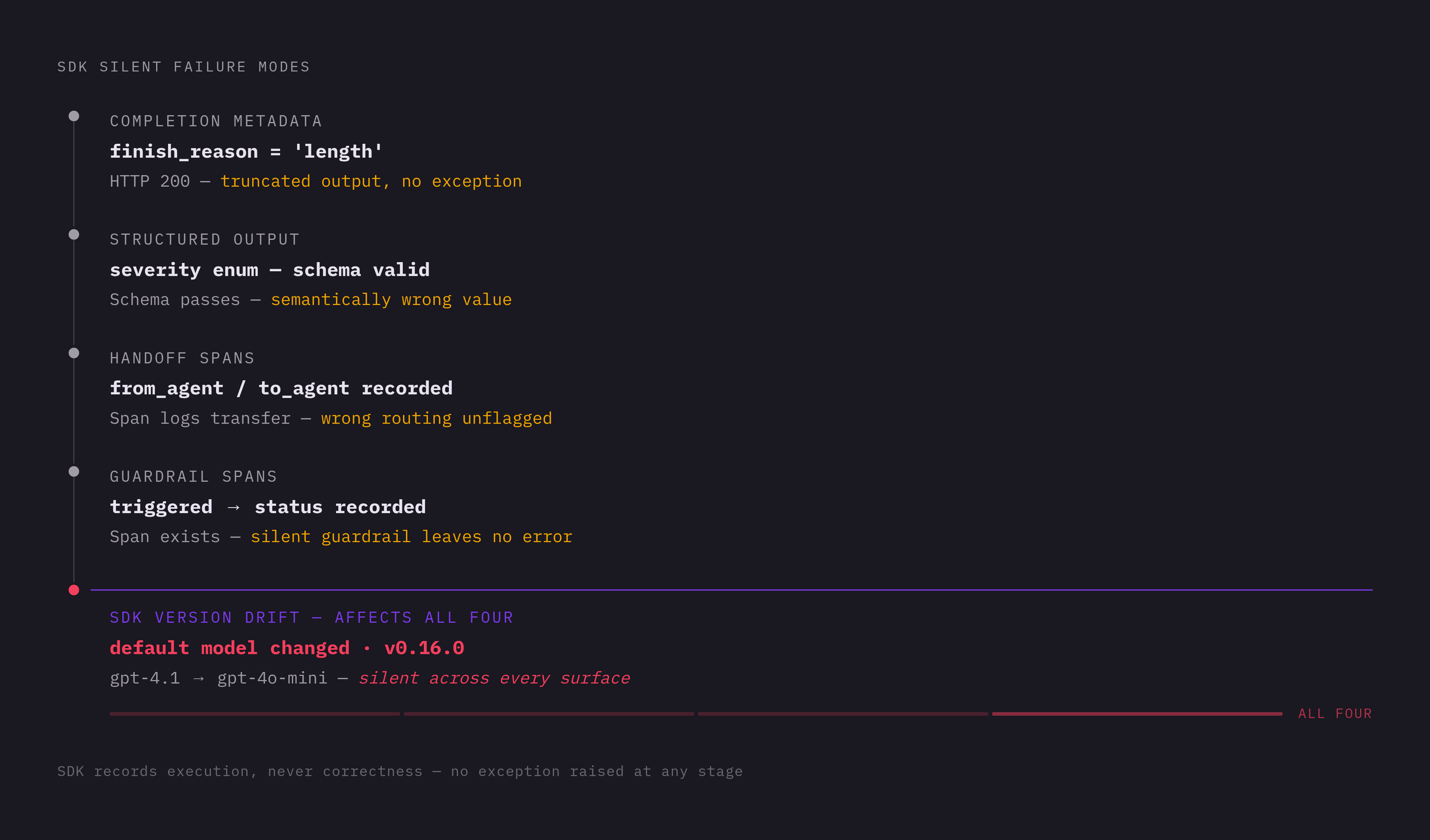
This completes the four-primitive view of silent failure. Generation metadata, structured-output parsing, handoff spans, and guardrail spans expose different evidence, so one generic success score cannot replace their individual checks. The instrumentation is already largely present. Its usefulness depends on reading each event against the behavior that the agent was supposed to exhibit.
How silent SDK version changes create a fifth failure surface teams don't anticipate
OpenAI’s v0.16.0 release notes state that the default model changed from gpt-4.1 to gpt-5.4-mini, affecting agents and runs without an explicit model. No upgrade-time error identifies this as a quality regression. An unchanged agent definition can therefore produce behavior from a different model after the SDK changes.
The new model’s defaults include reasoning.effort="none" and verbosity="medium". Those settings belong to the behavioral baseline. Different model behavior can change typed field values, handoff choices, guardrail outcomes, and token use. The structure of a trace can look healthy through all of those changes. Quality baselines from 0.13.x are consequently not directly comparable with 0.16.0+ output when the model was left implicit.
OpenAI’s v0.15.0 release notes describe another change in how refusals are handled. Refusal-only responses that previously completed with empty text output now raise ModelRefusalError, affecting code that expected final_output == "". This change makes a previously quiet outcome explicit. It can also break application logic that treated the empty string as a graceful noop. Version changes can therefore alter both what the agent produces and how the runtime reports an outcome.
The deployment mitigation is to pin model= on every Agent instantiation and set reasoning_effort and other model-level parameters explicitly. Pinning removes one hidden variable from comparisons before and after an upgrade. Version drift is a fifth failure surface because it can change several primitives at once, with effects that go beyond a fault in a single span.
What the SDK's own trace output gives you to detect these failures, and what it doesn't
The SDK’s tracing documentation describes automatic agent, generation, function, handoff, and guardrail spans. Tracing is enabled by default and exports to OpenAI’s backend, while OPENAI_AGENTS_DISABLE_TRACING=1 disables it. The trace supplies the execution record. Completion metadata exposes termination reasons, HandoffSpanData identifies routing direction, and GuardrailSpanData separates guardrail behavior from answer quality. Structured-output parsing adds evidence of schema conformance.
What remains missing is the evaluation standard. The SDK does not supply per-field value rubrics, expected-handoff ground truth, guardrail coverage assertions, or a mechanism that groups recurring failures across traces into issues. A generic TaskCompletion score judges a different object when it reads only the final answer. Per-primitive evaluations must use the evidence in spans to produce metrics that tell truncation, wrong values, wrong destinations, and missing protection apart.
The SDK uses its own tracing architecture rather than native compatibility with OpenTelemetry’s GenAI semantic conventions. OTel-compliant spans and OTLP export require contributed instrumentation or a custom processor. Export makes the evidence available to external evaluation and alerting systems, where the appropriate checks still have to exist.
The operational gap extends beyond collecting spans. The SDK does not provide the scheduler, retry policy, audit log, or operations dashboard described by a complete monitoring workflow. Teams need to build or add those functions for production deployments. The useful comparison criterion for monitoring tools is therefore whether they can evaluate typed events, retain expected behavior, group recurring defects, and support verification.
Closing the loop from silent failure to verified fix for Agents SDK deployments
Closing the loop begins by recording executions and auditing their traces against the agent’s own instructions. This supplies the context needed to judge typed values that schema validation accepts. It also turns finish_reason == 'length' into an alertable event. The unit of review is the operation and its intended result.
Failures that keep happening then need to become named issues. Cases of misrouting on the same directed pair belong together, as do cases of guardrail silence for the same input class. Reviewing traces one at a time cannot keep up as failures recur. Grouping preserves the common defect while retaining the examples needed to diagnose it.
The diagnosis should include span data from the primitive that failed and what it was expected to do. For a handoff, that means the recorded destination compared with the required target. For a guardrail, it means invocation or activation gaps on inputs that required protection. A Markdown brief can package what failed, which span exposes it, what the trace shows, and what the instructions require. Delivering that brief to a coding agent over MCP keeps the fix within the engineer’s existing workflow.
Failures in production should then become new evals automatically. A routing fix needs verification against the input that exposed the misfire, and a guardrail change needs the input that passed through incorrectly. This avoids rebuilding context and hand-written assertions for every incident. The resulting feedback loop turns an exception-free failure into a specific issue, a contextualized fix, and a test that can detect its return.